
Finance Operations
9 Best Returns and Warranty Claims Management Software Tools for 2026
Compare the 9 best returns and warranty claims management software tools for 2026, from dealer portals and RMA platforms to AI agents that work the claim.
- Von
-
 Filip Rejmus
- Veröffentlicht
- Lesezeit
- 17 Min. Lesezeit
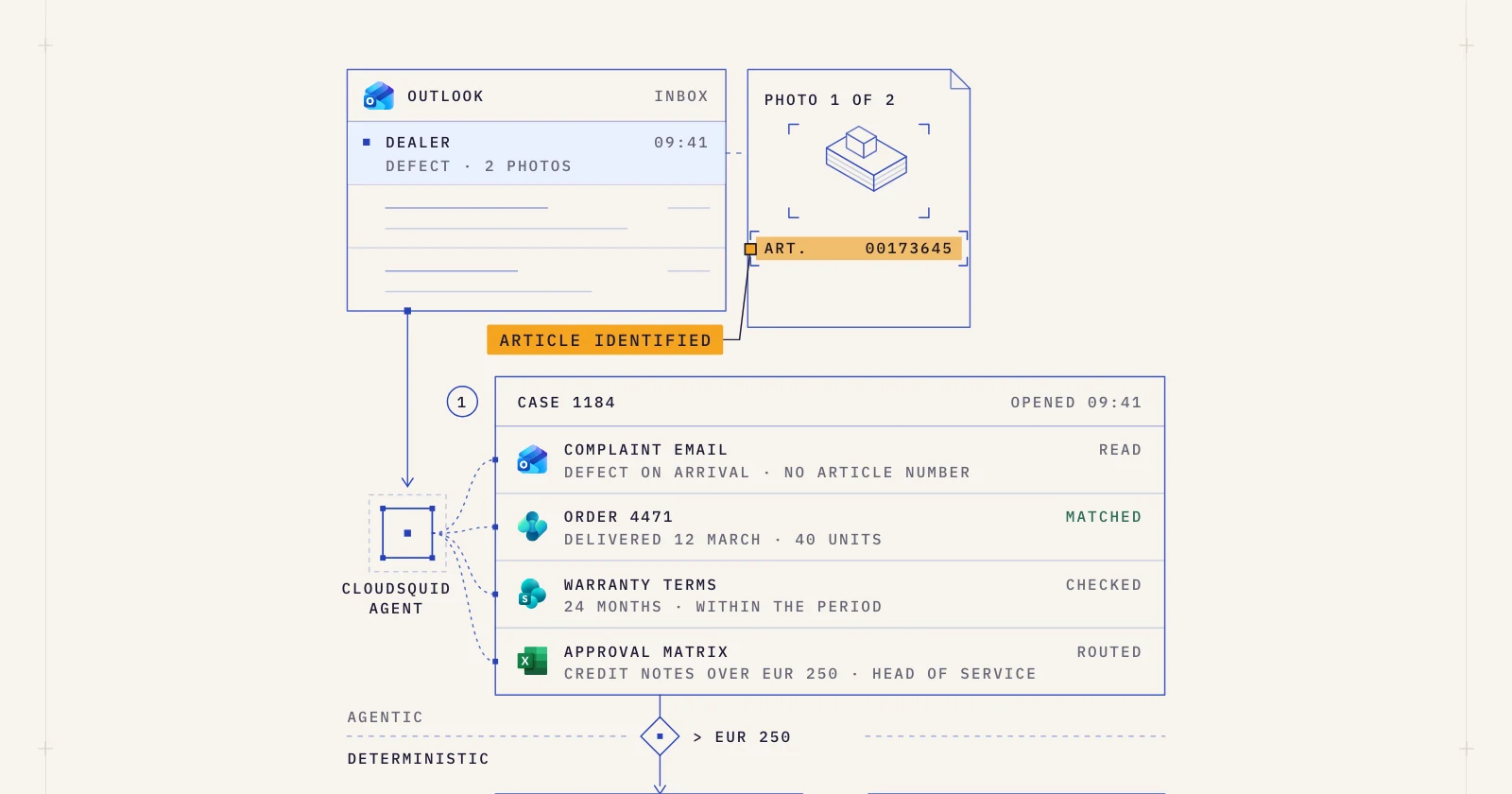
A dealer writes to your service mailbox: "The hinge on a cabinet from last month's delivery arrived bent, photo attached. Please send a new one or credit us." There is no article number, no order number and no serial number. Someone on your team opens the photo, works out which article it shows, searches the dealer's orders, finds the delivery and reads the warranty terms.
Most software in this category starts once the claim has been entered in a system. It gives the claim a home: a portal form, an RMA number, a warranty registry, a status page. That is recording and tracking. Working the claim is everything in between: identifying the article, finding the order and the delivery, checking purchase date, serial or batch and the terms, deciding under your policy, and preparing the credit note or the replacement.
This guide is about B2B claims: brands and manufacturers handling complaints, returns and warranty claims from dealers, retailers and trade customers. Consumer e-commerce returns are a different market. The line is also moving: several systems below now add AI that validates or adjudicates claims inside their own workflow.
This post covers the best returns and warranty claims management software for 2026: what each tool does, who it is built for, and where it sits between recording a claim and working it.
Best Returns and Warranty Claims Management Software at a Glance
| Tool | Best for | Standout |
|---|---|---|
| cloudsquid | Brands and manufacturers whose dealer claims arrive in a shared service mailbox | AI agents work each claim from the email: identify the article, find the order and delivery, check the terms, prepare the credit note or replacement for approval |
| Claimlane | Brands and retailers that want claims submitted through a portal | B2B partner portal with brand-specific rules, plus forwarding to suppliers |
| ReverseLogix | Manufacturers and distributors with bulk returns under account-specific terms | Bulk RMAs checked line by line against each account's entitlement |
| Tavant | OEMs with dealer and service networks | Warranty suite with AI agents for claim creation and adjudication |
| Syncron | Manufacturers that run warranty next to service parts planning and pricing | One warranty platform connecting customers, dealers and suppliers |
| PTC | Manufacturers that treat warranty as part of service lifecycle management | Central rules for claims, returns and supplier recovery, with field feedback to engineering |
| Salesforce Manufacturing Cloud | Manufacturers that already run sales and service on Salesforce | Assets, warranties and claims in one data model, with a partner portal |
| SAP S/4HANA | SAP-centric companies that want claims and returns inside the ERP | Warranty claims, returns orders and credit memos in the same system as finance |
| Babtec | Quality teams that process customer and supplier complaints with 8D | Guided 8D reports that can be shared with suppliers in the cloud |
1. cloudsquid: AI Agents That Work the Service and Returns Mailbox
Most tools on this list begin when a claim is entered into a system, usually through a portal form. In many B2B companies the claim arrives as an email in a shared service or returns mailbox, with a photo attached and half the details missing.
cloudsquid is an autonomous inbox for finance and operations teams at companies that make, move and sell physical products. Every message in the mailbox becomes a task with its own AI agent. For service, returns and claims, a typical case looks like this: a dealer sends a complaint with a photo and no article number. The agent identifies the article, finds the order and the delivery, checks the claim against your return policy and warranty terms, and prepares the credit note or the replacement for approval.
The work it replaces is the lookup work that fills a service desk's day: opening the photo, searching orders by customer and date, comparing the purchase date and the serial or batch with the terms. Your team gets the approvals it wants to keep and the exceptions, each with the evidence attached.
What makes cloudsquid different for returns and warranty claims:
One inbox covers email, PDFs, EDI, customer and supplier portals and Teams, and your people keep working in Outlook, Teams or the cloudsquid workspace.
The agents learn your process from your SOPs, files, email and ERP history. Rules, approval limits and escalation paths are set by your team, versioned and auditable, and approvals stay with people where you want them. Every case keeps a full evidence trail. When an agent cannot resolve a case, the team gets it with the evidence attached, and the resolution becomes a rule so the same exception does not come back.
cloudsquid is not a warranty management suite, a returns portal or a quality management system. If you need a dealer portal with product registration, a warehouse process for receiving and grading returned goods, or 8D reports, the tools below are built for that. cloudsquid is the agent layer that does the work in the inbox. It works on top of your existing ERP and does not replace it, and the same platform also handles customer orders, freight, deductions and supplier invoices.
Who cloudsquid is built for:
Customer service and order management teams at brands, manufacturers and distributors and wholesalers whose complaints, returns and warranty claims come in by email from dealers, retailers and trade customers, and where someone looks up each case by hand.
2. Claimlane: Claims and Returns Portal for Brands and Retailers
Claimlane is a claims and returns platform from Denmark for brands and retailers. It replaces email threads and spreadsheets with self-service portals and a shared case view, for what the company calls "B2C and B2B warranty claims from start to finish."
For B2B, retailers and dealers submit claims through a partner portal, where the brand sets the rules they see before they submit.
Key capabilities:
- B2B partner portal: Retailers, suppliers and dealers submit and manage structured claims without email.
- Forward to suppliers: Claims are forwarded to the supplier with photos, order details and fault reason attached, and the credit note is recorded against the claim.
- AI Agent: An agent trained on the company's policies and past cases proposes an action plan per ticket, within limits the team sets for what it may approve, reject or escalate.
- Integrations: Claimlane lists connections to Shopify, Microsoft Dynamics 365 Business Central, SAP, NetSuite, Zendesk and Salesforce.
Claimlane's standout capability: Structured claims from the trade
The portal moves the dealer from a free-text email to a guided submission: the retailer picks a ticket type, and identifiers and photos are collected upfront. With an ERP connected, the company says credit notes, replacements and refunds update automatically.
Who Claimlane is built for:
Brands and retailers in categories such as furniture, outdoor and sporting goods, baby products, DIY and electronics that want consumer and trade claims in one portal. Claimlane states implementation times of 2 to 4 weeks for simple setups and 4 to 8 weeks for complex ones.
3. ReverseLogix: B2B Bulk Returns and RMA Platform
ReverseLogix, based in California with an EU office in Dublin, runs returns, warranty and repair on a single system of record. It describes its B2B product as "the system a manufacturer or distributor uses to approve, receive and credit bulk returns." The focus is the physical return and the account's contract.
Key capabilities:
- Bulk RMAs: One consolidated RMA is tied to one account, with serial or batch tracking.
- Entitlement checks: Entitlements are applied at line level before the credit posts.
- Warranty claims: Serial number, registration, purchase date, coverage and exclusions are checked at intake, and approved claims route to repair, replacement, advance exchange or credit.
- Receiving and disposition: Receipt is checked against the RMA, and each line routes to a disposition such as restock, refurbish, return to vendor or scrap.
- ERP connectors: Standard connectors cover SAP S/4HANA, Oracle, NetSuite and Microsoft Dynamics 365, and finance data stays in the ERP.
ReverseLogix's standout capability: Line-level entitlement on bulk returns
What a B2B customer may return depends on its contract: return caps, stock balancing clauses, partner-specific terms. ReverseLogix applies those terms as rules, line by line, so the credit matches the contract without a manual lookup. Its Vision AI proposes a condition grade from uploaded photos. In the company's words, "the AI proposes and your rules and people decide."
Who ReverseLogix is built for:
ReverseLogix names wholesale distributors, dealers and manufacturers with annual revenue from about $50M to $5B or more, especially those with negotiated terms per account. The company says itself that it is not the right fit for single-channel direct-to-consumer brands with one standard policy.
4. Tavant: Warranty Suite With AI Agents for Dealer Networks
Tavant offers a modular warranty management solution for manufacturers. The modules cover warranty administration, claims, part returns, supplier recovery, product registration, service campaigns, analytics and audit, and customers select the ones they need.
Tavant has added AI agents on top. A Claim Creator Agent connects to the dealer's management system, identifies warrantable costs in a work order and generates the claim on the dealer's behalf. An AI Adjudicator Agent evaluates claims, and a Partner Assist Agent handles labor rate updates, inquiries and policy clarifications.
Key capabilities:
- Claims management: Covers claims processing, warranty authorizations and recovery for OEMs and end users.
- Supplier recovery: Recovery claims are created automatically from the defined supplier contracts, and suppliers view and action them in their own portal.
- Part returns: Manages part repairs, returns and refurbishment.
- Service campaigns: Notifies dealers and customers and tracks completion rates.
- Suspect claim analytics: Flags claims that look fraudulent or suspicious for investigation.
Tavant's standout capability: AI adjudication of dealer claims
Tavant's adjudicator works on what a warranty system already holds: structured claim data, suspect parameters, failure cluster insights and warranty analytics. That suits networks where claims arrive in volume and the open question is which ones need a human reviewer.
Who Tavant is built for:
OEMs with dealer and service networks, where warranty covers parts, labor and recovery from suppliers. Tavant has announced warranty projects with Daimler Truck North America and Kubota Tractor Corporation.
5. Syncron: Warranty Lifecycle Platform for Aftermarket-Focused Manufacturers
Syncron sells aftermarket software for OEMs: service parts planning, service parts pricing and warranty management. Syncron Warranty goes back to Mize, the warranty software firm that merged with Syncron in 2021. According to Syncron, the product connects manufacturers with their customers, dealers and suppliers, so claims, returns and service plans run on one solution.
Key capabilities:
- Claims processing: Claims move through connected workflows with multi-level approval and role-based routing.
- Product registration: Product registrations are tracked, which supports the sale of extended warranties and service plans.
- Supplier recovery: A dedicated capability aims to maximize what is recovered from suppliers.
- Analytics: Standard reports draw on a centralized warranty data warehouse and can be shared with dealer channels and suppliers.
Syncron's standout capability: One platform for dealers and suppliers
Warranty has two sides: the dealer who wants to be reimbursed and the supplier who may owe part of the cost. Syncron connects both with the manufacturer on a single platform, which the company calls a single source of truth.
Who Syncron is built for:
Manufacturers of durable equipment and vehicles that sell and service through dealers. Syncron shows companies such as Volvo, Komatsu and Caterpillar among its customers and says it is "trusted by manufacturers in 80+ countries."
6. PTC: Warranty as Part of Service Lifecycle Management
PTC Warranty covers four areas: claims and returns management, supplier recovery, parts and service order management, and warranty analytics. PTC positions it as one component of its service lifecycle management portfolio, next to ServiceMax and the service parts product Servigistics.
One ownership note for buyers: on October 5, 2026, PTC and Schneider Electric announced a definitive agreement under which Schneider Electric will acquire PTC. Closing is anticipated by the third quarter of 2027, subject to shareholder and regulatory approvals.
Key capabilities:
- Claims and returns management: Warranty coverage and business rules are standardized, and claims and returns are managed centrally.
- Supplier recovery: Recovery from suppliers is managed centrally, together with claims and returns.
- Parts and service orders: Addresses delays in ordering parts and missing visibility of open orders.
- Warranty analytics: Warranty data is analyzed to improve product and warranty performance.
- Configurable forms: Release 5.5 added configurable forms for the product registration and RMA screens.
PTC's standout capability: Closed-loop feedback to engineering
PTC describes a closed loop in which feedback from the field goes directly back to the manufacturer for timely and continual product improvement, which reduces future warranty cost.
Who PTC is built for:
Manufacturers with their own service organization that want warranty connected to field service and service parts. PTC states that IDC named it a Leader in the IDC MarketScape 2024 for worldwide warranty service management applications.
7. Salesforce Manufacturing Cloud: Warranty Lifecycle Management on the CRM
Salesforce covers warranty inside Manufacturing Cloud. The company describes a native data model built to manage assets, warranties and claims in one place. Partners and customers submit claims through portals or an API, and business rules automate claim approvals.
Key capabilities:
- Warranty programs: The manufacturer defines program terms such as warranty duration, usage limits and covered parts.
- Partner portal: Distributors and dealers register assets, submit claims and check repair entitlements through an Experience Cloud portal.
- Rule-based approval: The Business Rules Engine uses low-code decision matrices to automate claim approvals.
- Supplier recovery: Customer claims are linked to supplier contracts so that finance can charge vendors for faulty components.
- Asset Service Console: Service teams see the warranties, cases, work orders and claims related to an asset.
Salesforce's standout capability: Claims next to the customer and the asset
The value of doing warranty in the CRM is context. The service agent who takes the dealer's call sees the asset, its warranty, its cases and its claims in one console.
Who Salesforce is built for:
Manufacturers that already run sales and service on Salesforce and want dealer claims on the same platform. Salesforce says business users can define and change adjudication rules with no-code to low-code tools.
8. SAP S/4HANA: Warranty Claims and Returns Inside the ERP
SAP covers this category in several places inside S/4HANA. Warranty Claim Management in SAP S/4HANA Cloud Public Edition handles customer claims and supplier recovery. In Sales, complaints processing covers credit and debit memo requests, invoice corrections, free-of-charge subsequent deliveries and customer returns. Each process starts when a claim or a returns order is created in the system.
Key capabilities:
- Customer claim processing: A claim is created after a repair, validated for completeness and eligibility for reimbursement, accepted or rejected, and posted to finance.
- Supplier recovery: A claim is created, validated and sent to the supplier, the response is recorded, and the amount is posted.
- Advanced Returns Management: Returns order, inspection, logistical follow-up and refund run as one integrated process that SAP says is available by default in S/4HANA.
- Refund control: A credit memo request can be triggered automatically and routed through an approval workflow, and the refund can be a credit or a replacement.
SAP's standout capability: The claim and the posting in one system
When the claim lives in the ERP, there is no handover between a claims tool and finance. A return runs from returns order to goods receipt to credit memo in one system, and an accepted warranty claim is posted to finance directly.
Who SAP is built for:
SAP-centric manufacturers and distributors that want claims, returns and credit memos in the system that already holds their orders and deliveries, and that have a defined way to get each claim into SAP.
9. Babtec: Complaints Management With 8D for Quality Teams
Babtec is a quality management software company based in Wuppertal, Germany, founded in 1994. Its Complaints Management module is part of the BabtecQ suite. The company sums it up as creating customer and supplier complaints and processing them with the 8D method.
This is the quality side of a complaint. A commercial claim asks whether the dealer gets a credit note. A quality complaint asks why the defect happened and what stops it from happening again.
Key capabilities:
- 8D reports: Guided data entry leads the team through the eight standardized steps.
- Customer and supplier complaints: Complaints can be created directly from events such as an incoming goods inspection.
- Root cause analysis: Error catalogs support a targeted analysis of causes.
- Action management: Configurable workflows and a central Action Management track corrective actions.
- ERP exchange: Complaint data can be imported from the ERP system and sent back to it.
Babtec's standout capability: 8D collaboration with suppliers
Through BabtecQube, its cloud platform, a manufacturer can share a complaint with the supplier and work on the quality issue together in one place. That helps in supply chains where customers expect an 8D report with every complaint.
Who Babtec is built for:
Quality managers at manufacturers in industries such as automotive, electronics, mechanical engineering and medical engineering. Babtec says its customers range from medium-sized family businesses to international corporations.
How to Choose the Right Returns and Warranty Claims Management Software
These tools solve different parts of the problem. Answer these questions about your own process first.
1. Where do claims arrive today, and can you change that?
If dealers and trade customers write emails and will keep writing emails, you need something that works the mailbox. That is what cloudsquid is for. If you can move submission into a form, a portal collects the identifiers upfront: Claimlane for brands and retailers, ReverseLogix for account-based returns, Salesforce for dealers who already use your partner portal.
2. Is the hard part the physical return or the decision?
When pallets come back and have to be received, inspected and dispositioned, look at ReverseLogix or the returns processes in SAP. When the work is finding the order, checking the terms and issuing a credit note or a replacement, the bottleneck is the decision. That is where cloudsquid, Claimlane's AI Agent and Tavant's adjudication sit.
3. Do you reimburse a dealer and service network for repairs?
Warranty claims with labor, parts and supplier recovery are the home ground of Tavant, Syncron and PTC. Salesforce Manufacturing Cloud and SAP S/4HANA cover the same process for companies that want it on their CRM or their ERP.
4. Is the complaint a commercial claim or a quality issue?
A credit note settles the claim with the customer, and the defect is still unexplained. If your customers expect an 8D report, or complaints have to feed corrective actions, you need quality software such as Babtec next to whatever handles the commercial side.
5. Which system should hold the record?
SAP-centric companies often want the claim next to the financial posting. Salesforce customers want it next to the account and the asset. cloudsquid works on top of the ERP you already have and does not replace it.
What Good Returns and Warranty Claims Handling Looks Like in Practice
The difference between recording a claim and working it shows in the first hour after a complaint arrives.
When a claim is only recorded, it gets a number and a status, and then it waits. Someone still has to identify the article, find the order and the delivery, and read the terms.
When the claim is worked, the lookups are done before a person opens the case. The article is identified, the order and the delivery are attached, the purchase date and the serial or batch are compared with the warranty terms, and a proposed decision is ready: credit note, replacement or a reasoned rejection.
Good handling is also consistent. Two dealers with the same claim get the same answer, because the decision follows the written policy and can be traced to the rule and the evidence behind it.
The record still matters. Quality needs to see which articles and batches come back, finance needs the credit notes to match the deliveries, and suppliers need evidence when you pass a cost on. Your service team then spends its time on the cases that need judgment: the unclear photo, the goodwill decision for an important dealer, the defect nobody has seen before.
Frequently Asked Questions
What is warranty claims management software? Warranty claims management software handles a warranty claim from submission to settlement. It registers products and coverage, takes in claims from dealers and customers, validates them against the warranty terms, and supports approval and payment or credit. For manufacturers, it usually also covers dealer claims management, parts returns and supplier recovery.
What is the difference between RMA software and warranty management software? RMA software authorizes and tracks the physical return of goods: it issues the return merchandise authorization, controls receiving and inspection, and triggers the credit. Warranty management software decides whether a failure is covered and what is reimbursed, often without the product coming back. Platforms such as ReverseLogix combine both.
How is B2B returns management software different from consumer returns tools? A B2B return belongs to an account with negotiated terms. One return can contain many lines from several invoices, need more than one approval and end as a credit memo in the ERP. Consumer tools are built around labels, exchanges and refunds for single orders.
What is complaint management software for manufacturers? In manufacturing, the term usually means quality software that records customer and supplier complaints and processes them with methods such as 8D. Babtec is an example. It explains why a defect happened, while the commercial settlement with the customer is a separate step.
Does claims software replace the ERP? No. The ERP stays the system of record for orders, deliveries, credit memos and inventory. Portals and warranty platforms connect to it, and SAP customers can also run claims and returns inside S/4HANA. cloudsquid works on top of the existing ERP, is ISO 27001:2022 certified and offers EU data residency.
How long does it take to implement? Claimlane states 2 to 4 weeks for simple setups and 4 to 8 weeks for complex ones, and ReverseLogix states a standard implementation of 4 to 6 weeks. cloudsquid needs no integration project to start: the team forwards the mailbox and shares SOPs, sample cases and an ERP export, and agents work the inbox in the second week. Enterprise warranty suites and ERP processes are scoped as individual projects.
How do you measure ROI on claims software? Measure what the manual process costs today: time to first answer and to resolution, hours spent on lookups, credits issued outside policy, and warranty cost that could have been recovered from a supplier. To see how an agent handles the claims in your own mailbox, book a demo.
Related Comparisons
Über den Autor
Co-founder & CPO, Cloudsquid
Filip Rejmus, co-founder and Chief Product Officer at cloudsquid, is building infrastructure to help companies manage, scale, and optimize AI workflows. With a background spanning software engineering, data automation, and product strategy, he bridges the gap between AI research and building useful, friendly Products.Before founding Cloudsquid, Filip worked in engineering and data roles at Taktile, SoundHound, and Uber, and contributed to open-source projects through Google Summer of Code. He studied Computer Science at TU Berlin with additional coursework in Quantitative Finance at TU Delft and Computer Graphics at UC Santa Barbara.
Weiterlesen
Weitere Beiträge für Ihr Team.
Finance Operations 17 Min. Lesezeit
9 Best Sales Order Automation Software Tools for 2026
Artikel lesen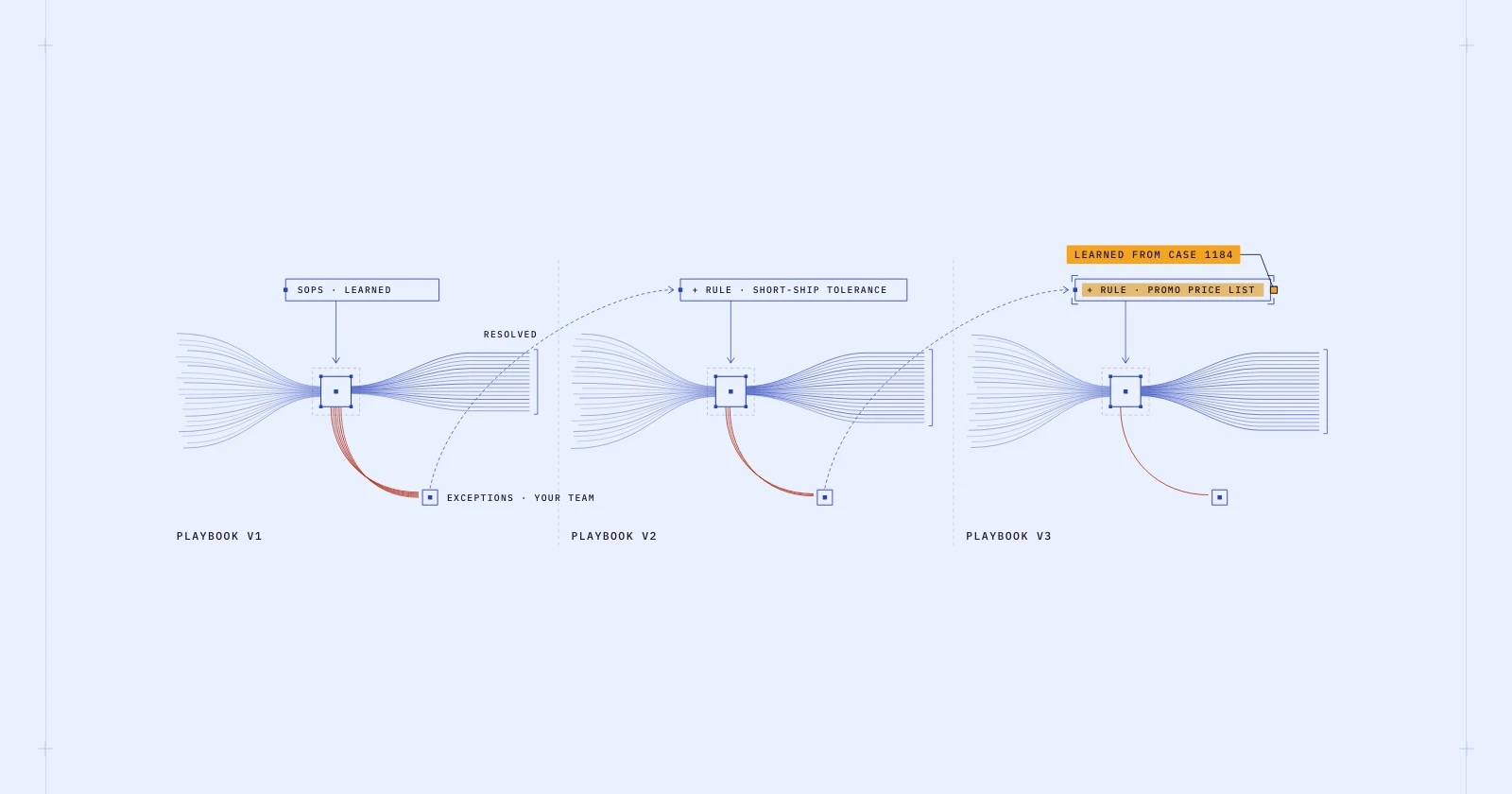
Finance Operations 17 Min. Lesezeit
9 Best AI Agents for Finance Operations in 2026
Artikel lesen
Finance Operations 17 Min. Lesezeit
9 Best B2B Customer Service Automation Tools for Manufacturers and Distributors in 2026
Artikel lesenNächster Schritt
Automatisieren Sie den Workflow hinter diesem Artikel.
Bringen Sie Ihre Dateien und Regeln mit. Cloudsquid setzt daraus in wenigen Wochen einen prüfbaren KI-Workflow um.