
Finance operations
9 Best Sales Order Automation Software Tools for 2026
Compare the 9 best sales order automation software tools for 2026: who each is built for, how they handle email and PDF orders, and how to choose.
- Written by
-
 Filip Rejmus
- Published
- Reading time
- 17 min read
The purchase order arrives at 7:42 as a PDF attached to a two-line email. The customer uses its own part numbers, orders 40 boxes of an item you sell by the pallet, and wants delivery to an address that is not on the account. Somebody on the order desk has to sort that out before anything reaches the ERP.
That is the gap between capturing an order document and working an order. Capture reads the PDF into fields. Working the order means matching each line to the right item, customer and price, checking it against the ERP, handling changes and confirmations, and sending only the real exceptions to a person.
Most vendors of sales order automation software now describe both. They differ in where the software stops and a person takes over, and in the kind of company they were built for.
This post covers nine sales order automation tools for 2026: what each does, who it is built for, and where it draws the line between reading the order and working it.
Best Sales Order Automation Software at a Glance
| Tool | Best for | Standout |
|---|---|---|
| cloudsquid | Order desks at manufacturers, distributors and consumer goods companies | Agents read each order, match customer and item data, enter it in the ERP and escalate only uncertain matches with the evidence |
| Conexiom | Manufacturers and distributors with many customers who email purchase orders | Plain-English customer rules the team can read, edit and lock |
| Esker | Customer service teams that want order management inside an order-to-cash suite | Email, EDI and portal orders on one platform, with built-in SAP and Oracle EBS connectors |
| Workist | Manufacturers and wholesalers that take orders by email, PDF and phone | Four agents on one platform: order entry, inbox inquiries, phone orders and ERP tasks |
| turian | Mid-market manufacturers and wholesalers with orders, quotes and tenders in one inbox | Agents for order entry, quoting and bills of quantities that work from Outlook or Gmail |
| Rossum | Enterprises and shared service centers processing many document types | Template-free document AI that validates orders against master data; part of Coupa since 2026 |
| Canals | Distributors and manufacturers in electrical, plumbing, HVAC and industrial supply | Turns emails, takeoffs and voicemails into draft quotes or orders matched to the catalog |
| SAP | Companies on SAP S/4HANA Cloud Public Edition that want order intake inside the ERP | Native app that extracts purchase order PDFs into a draft the rep reviews in SAP |
| SPS Commerce | Suppliers whose retail and distribution customers require EDI | Full-service EDI: the provider's team sets up and maintains trading partner connections |
1. cloudsquid: AI Agents That Work the Order Desk Inbox
cloudsquid is an autonomous inbox for finance and operations teams at companies that make, move and sell physical products. Every order that lands in the order desk's mailbox becomes a task with its own AI agent, whether it arrives as email text, a PDF, a spreadsheet, an EDI message or a portal message.
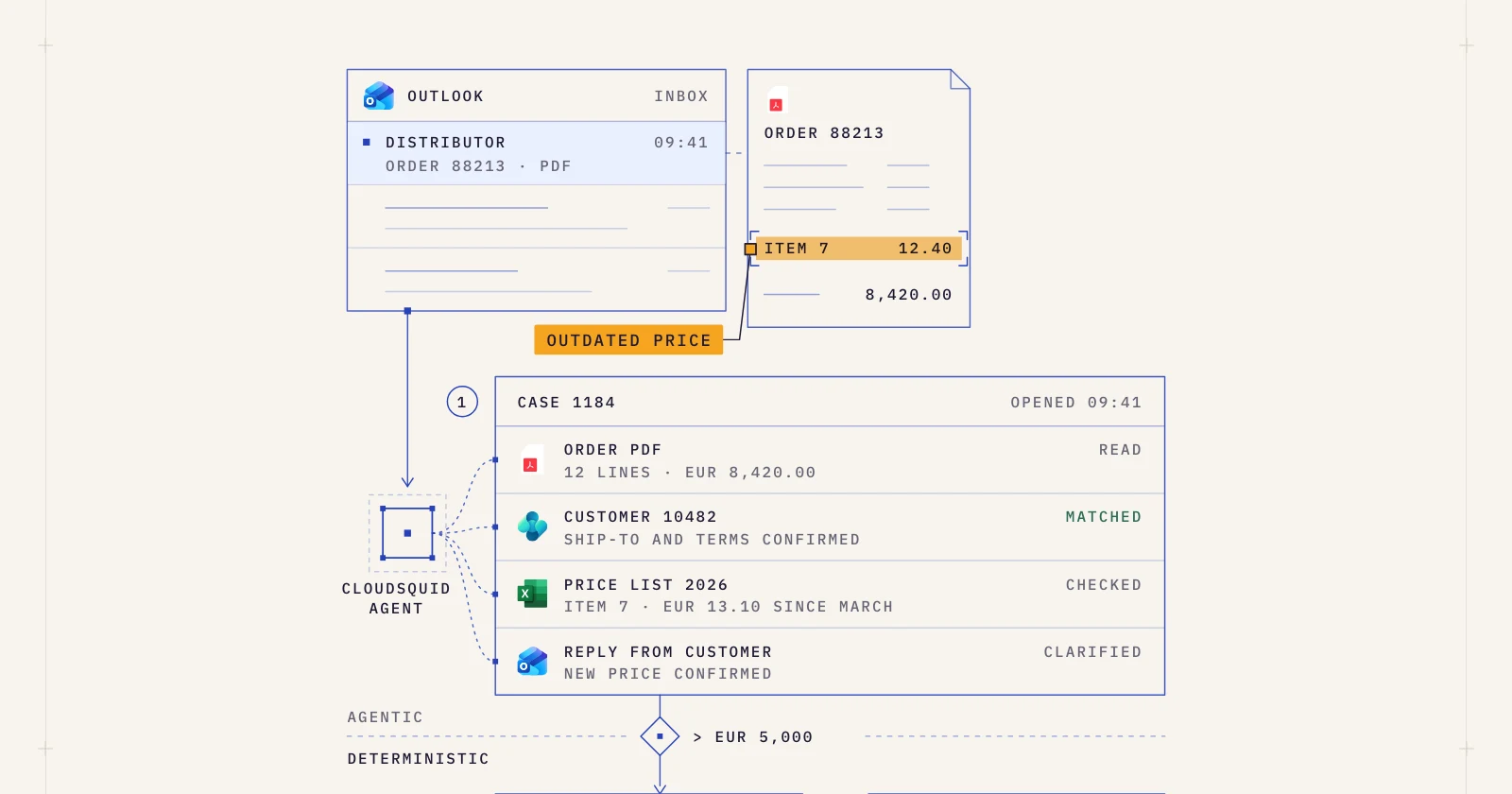
For customer orders, the agent does what an order entry clerk does. It reads the order, matches the customer and each line to the company's own items and prices, checks the order against the company's records and enters it in the ERP. A change to an open order (a new date, quantity or delivery detail) is made on that order, and the confirmation goes out once the order has cleared every check. When a match is uncertain, the order goes to a person with the evidence attached.
What makes cloudsquid different for sales order automation:
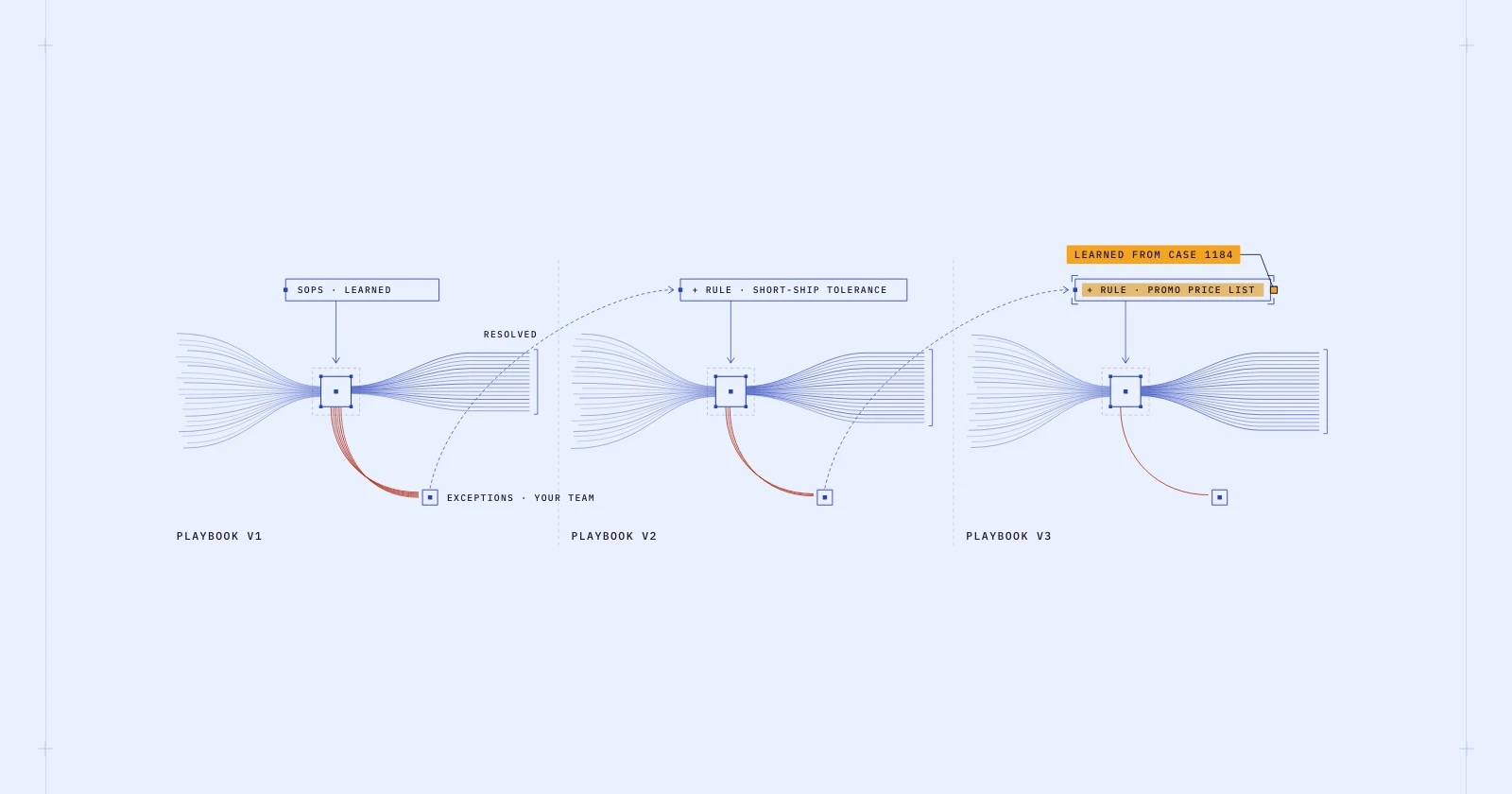
cloudsquid starts from the inbox instead of the document. Agents learn the order process from the company's SOPs, files, email and ERP history. The team sets the rules, thresholds, approval limits and escalation paths and decides what agents may do alone. When an agent cannot resolve an order, the team gets it with the evidence attached, and the resolution becomes a rule so the same exception does not come back.
It works on top of the existing ERP (SAP, Oracle NetSuite, Microsoft Dynamics 365, Workday, Infor), and the order desk keeps working in Outlook, Teams or the cloudsquid workspace. There is no integration project to start: the team forwards the mailbox and shares SOPs, sample cases and an ERP export, and agents work the inbox in week two.
cloudsquid is not an EDI network, a B2B ordering portal or an order management module, and it does not replace the ERP. It is the agent layer that does the order desk's work. A company whose customers all order by EDI needs an EDI provider first.
Two published results fit here. At Repa, agents run incoming purchase orders end to end, matching customer and item data and escalating only uncertain matches for human review. A mid-market CPG distributor saw 70% less manual order entry time.
Who cloudsquid is built for:
Order desks and customer service teams at manufacturers, distributors and wholesalers and consumer goods companies where orders arrive in many formats and people key them into the ERP. It fits best when the order desk is one of several inboxes with the same problem: the same platform also works returns and claims, freight, deductions and supplier invoices, so a team adds the next process without buying another tool.
2. Conexiom: Purchase Order Automation for Manufacturers and Distributors
Conexiom has focused on order automation for manufacturers and distributors for more than 15 years. The company states that it serves over 600 customers and processes more than 1.5 billion line items a year. Its product, Conexiom Relay, takes in orders as emails, PDFs, images, spreadsheets or handwritten notes, validates them against master data and sends ERP-ready data to the ERP.
Key capabilities:
- Capture: Sorts incoming orders and invoices by type and intent and extracts line items, quantities and part numbers.
- Resolve: Validates every document against master data, adds missing context and fixes mismatches before the order reaches the ERP.
- Playbook: Holds what Relay learns about each customer as plain-English rules the team can read, edit and lock.
- ERP integrations: Native integrations with more than 40 ERPs, including Epicor, SAP, Infor, Microsoft Dynamics 365, Oracle NetSuite and Sage, according to the company.
Conexiom's standout capability: Customer rules the team can read
Playbook turns what Relay learns into written rules that a customer service lead can open, change or lock. When an order needs a person, Relay passes it on with the reason in clear language. For teams wary of automation that picks up the wrong habit from one bad correction, that visibility is the point.
Who Conexiom is built for:
Conexiom is built for manufacturers and distributors with a large base of customers who email purchase orders. It names Epicor Eclipse and Prophet 21 among the ERPs it delivers to, and states an average implementation time of 30 days with no ERP changes required.
3. Esker: Order Management Inside an Order-to-Cash Suite
Esker sells automation across source-to-pay and order-to-cash. It has been privately held since its delisting in March 2025. Order Management is one of its customer service solutions, next to customer inquiry and claims management. It uses what the company calls Esker Synergy AI to capture order data and verify it against ERP reference data.
Key capabilities:
- AI data capture: Reads orders in XML, EDI, PDF and free-text email, and flags potential quantity anomalies using historical data.
- Order classification: Orders in the customer service shared inbox are categorized as standard, change or return orders.
- EDI and non-EDI together: EDI orders appear in a human-readable version on the same platform as email orders.
- ERP integration: Built-in connectors for SAP and Oracle EBS check prices and availability before the order is created.
- Web and mobile ordering: An order portal and a mobile app let customers place and track orders themselves.
Esker's standout capability: Every order channel in one place
Email, EDI and portal orders sit in one interface under the same business rules, with tracked conversations on each order and an audit trail of every touch point. A company that also wants to automate claims, deductions or cash application can stay with one vendor.
Who Esker is built for:
Esker fits customer service organizations that want order management as part of a broader order-to-cash program, in particular those on SAP or Oracle EBS. The company says its connectivity suite supports any ERP.
4. Workist: AI Agents for the Sales Back Office
Workist is a Berlin company that calls its product the agentic AI platform for sales. It has four agents: the Order Agent reads orders and creates them in the ERP, the Inbox Agent answers status, price and availability inquiries, the Phone Agent takes calls, and the ERP Automation Agent handles recurring ERP workflows.
Key capabilities:
- Order Agent: Reads PDFs, Excel files and email text, and understands new customer formats without templates.
- Master data matching: Matches articles by article number, customer-specific article number or description alone, and checks minimum quantities and delivery addresses against the ERP.
- Exception handling: Asks for human feedback when something is unclear and, in the company's words, escalates only real exceptions.
- ERP integrations: SAP S/4HANA, SAP ECC, Oracle NetSuite, Microsoft Dynamics 365 Business Central, Sage 100 and 200, proALPHA, ABAS and others, more than 40 systems according to Workist.
Workist's standout capability: Phone and inbox next to order entry
Workist puts order entry, inquiries and phone orders on one platform with the same master data. The company states that typically 60 to 90 percent of orders run fully automatically, with the rest reviewed by a team member before anything lands in the ERP.
Who Workist is built for:
Workist is built for manufacturers and wholesalers that receive orders and inquiries by email, PDF or phone. It says NetSuite and Business Central customers are usually live in a week, while SAP S/4HANA and ECC take about six weeks.
5. turian: Order Entry, Quotes and Tenders From the Inbox
turian is a Berlin company, founded in 2022 and formerly called Uify. It automates the processing of sales orders, quote requests, bills of quantities and supplier order confirmations. Its agents read incoming emails and attachments, match the data against ERP master data and create structured records, which people review and approve.
Key capabilities:
- Document reading: Processes free-text emails, PDF, Excel, Word and image files in any language, according to the company.
- Master data matching: Validates documents against customer data, product data and pricing conditions from the ERP and writes confirmed records back.
- Configurable rules: Custom rules check stock availability, delivery timelines or customer-specific pricing, and policies enforce user confirmation for sensitive updates.
- Follow-ups and replies: Agents can follow up on missing details and generate and send quotes or order confirmations.
- ERP integrations: SAP Business One, S/4HANA and ECC, Microsoft Dynamics 365, AX and NAV, Infor LN and M3, proALPHA, Oracle NetSuite, Sage X3 and Odoo.
turian's standout capability: Quotes and tenders alongside orders
A sales inbox mixes orders with quote requests and bills of quantities. turian handles all three, plus supplier order confirmations on the procurement side. For a manufacturer whose back office quotes as much as it enters orders, that scope can matter more than order volume.
Who turian is built for:
turian is built for mid-market manufacturers, distributors and wholesalers. It is certified to ISO 27001:2022 and hosts its AI models and servers in Europe. The company states that implementations typically take four to six weeks.
6. Rossum: Document AI for Enterprise Order Management
Rossum is an AI document processing platform for transactional documents such as invoices, sales orders and bills of lading. Coupa announced on May 12, 2026 that it had acquired Rossum. The announcement centers on invoice processing and source-to-pay, so buyers considering Rossum for order intake should ask about plans for its order management solution.
Key capabilities:
- Multi-channel order capture: Processes orders from email, EDI, web portals and mobile apps on a platform Rossum describes as template-free.
- Order validation: Verifies customer information, inventory availability and pricing against business rules, and alerts on discrepancies with master data.
- Routing and approvals: Routes problem orders to human review and supports configurable multi-level approvals.
- Transactional language model: A proprietary model that, according to Rossum, supports 276 languages and handwriting.
- Integrations: SAP, Coupa, NetSuite, Workday and Microsoft Dynamics.
Rossum's standout capability: One document platform for many processes
The same platform serves accounts payable, customs clearance, order management and quality assurance, so a shared service center can use one tool for all of them. Rossum also describes AI agents that read documents, validate data, send emails and write to the ERP in line with the company's SOPs.
Who Rossum is built for:
Rossum is built for enterprises and shared service centers with high document volumes in many languages and layouts, where order intake is one of several document processes on a single platform.
7. Canals: AI Order Entry for Construction and Industrial Supply
Canals describes itself as AI for manufacturers, distributors and contractors in the construction and industrial supply chain. The company states that more than 100 distributors use it. When a message arrives in a rep's inbox, Canals identifies whether it is an order or a quote request and drafts it with the best catalog matches for each item. The rep reviews the draft and submits it to the ERP with a click.
Key capabilities:
- Any input format: Handles handwritten notes, takeoffs, spreadsheets, PDFs and voice audio, with no templates or part numbers required.
- Product matching: Proposes matches for each requested product with branch-based availability, pricing and non-stock sourcing.
- Phone and counter orders: Transcribes calls and voicemails into ERP-ready orders and builds quotes from conversations at the counter.
- ERP integrations: Epicor Eclipse and Prophet 21, Infor CloudSuite Distribution, SX.e and M3, Acumatica, NetSuite, Microsoft Dynamics 365 and SAP S/4HANA, among others.
Canals's standout capability: Matching vague material lists to the catalog
A contractor's material list rarely carries the distributor's part numbers. Canals is built around that problem: it reads what the customer wants and proposes the catalog items, so the inside sales rep confirms a draft. The same flow covers RFQs.
Who Canals is built for:
Canals is built for distributors and manufacturers of construction and industrial materials. Beyond order entry it offers accounts payable and PO tracking. The company says customers can be up and running in under a week.
8. SAP: Order Intake Inside S/4HANA
Companies on SAP S/4HANA Cloud Public Edition have an order intake option inside the ERP. In the Create Sales Orders - Automatic Extraction app, an internal sales representative uploads a purchase order as a PDF or image file. The system extracts it into a sales order request, a draft that precedes the sales order, and proposes master data such as the sold-to party and product. The rep completes the request and converts it into a sales order.
Key capabilities:
- Automatic extraction: Reads purchase order files in PDF or image format. SAP documents that files must be in English or German.
- Side-by-side review: The sales clerk verifies the extracted data against the original document before posting.
- Simulation: The rep can simulate order creation and see the causes of errors first.
- Email automation: For high volumes, SAP describes an additional layer built with SAP Build Process Automation that monitors incoming email attachments, so that only exceptions need review.
SAP's standout capability: No second system
The order never leaves SAP. Master data, the sales order request, the change log and the final order live in one system, with no additional vendor to assess. For an SAP shop with moderate volumes of PDF orders in English or German, that may be enough.
Who SAP is built for:
SAP's own order intake is for S/4HANA Cloud customers that want to cut manual entry without adding a tool. Companies with orders in other languages or formats, or with more than one ERP, will usually compare it with the specialist tools. Scope differs by release and edition, so check what your system includes.
9. SPS Commerce: The EDI Route for Structured Orders
EDI is the other way to stop typing orders: the customer's system sends the purchase order as a structured message, and there is no document to read. SPS Commerce has connected suppliers with their retail trading partners since 2001 and states that it has more than 46,000 subscribing customers. Its EDI product, SPS Commerce Fulfillment, brings orders, shipping notices and invoices from every channel into one dashboard.
Key capabilities:
- EDI document exchange: Handles documents such as the purchase order (EDI 850), ship notice (EDI 856) and invoice (EDI 810).
- System integration: Pre-built integrations for systems such as NetSuite, SAP and Microsoft Dynamics, and the company says it will build one where none exists.
- Trading partner onboarding: Implementation staff contact the retailer and set up the connection for the supplier.
- Testing and certification: Services to confirm the setup meets each trading partner's requirements.
SPS Commerce's standout capability: Someone else maintains the connections
Every retailer has its own EDI specification. SPS describes its service as full-service: its team keeps the mapped connections current across its network, so a supplier does not have to configure or update specifications itself.
Who SPS Commerce is built for:
SPS Commerce is for suppliers and distributors whose customers require EDI, above all in retail and grocery. The customer who emails a PDF is outside EDI by definition, so an order desk with both kinds of customers needs both routes.
How to Choose the Right Sales Order Automation Software
Five questions about your own order desk narrow the list.
1. How do your orders arrive?
Count a normal week by channel. If most orders can come as structured messages, start with an EDI provider such as SPS Commerce or TrueCommerce. If most arrive as PDFs and email text, look at Conexiom, Workist, turian, Esker or cloudsquid. If many come by phone or at the counter, Workist and Canals cover voice.
2. Where does the reading stop and the work start?
Ask every vendor what happens after extraction: who matches the customer's part number to yours, and what a reviewer sees when the system is unsure. In SAP's standard extraction app and in Canals, a rep reviews each draft before it becomes an order. turian has people review and approve the agents' output. cloudsquid, Conexiom and Workist describe a flow in which only the unclear orders reach a person.
3. Which ERP do you run?
On SAP S/4HANA Cloud, test the native apps first. Workist and turian list SAP S/4HANA and SAP ECC. On Epicor Prophet 21 or Eclipse, Conexiom and Canals name those systems. If you run more than one ERP, look at tools that connect to several, such as Esker, Conexiom and cloudsquid.
4. Is the order desk the only inbox with this problem?
The same people often handle complaints, returns and credit notes. If those are next, the platform matters more than the order feature. Esker covers customer inquiries, claims and accounts receivable. Canals and turian extend into purchasing. cloudsquid works the next inbox (returns and claims, freight, deductions, supplier invoices) on the same platform.
5. Who decides what runs without a person?
Ask where the rules live, who can change them, and what the audit trail shows for a single order. Conexiom's Playbook keeps customer rules in plain English. In cloudsquid the team sets rules, thresholds and approval limits, and the rules are versioned. For European companies hosting matters too: Workist and turian state that they host in Europe, and cloudsquid offers EU data residency and is ISO 27001:2022 certified.
What Good Sales Order Automation Looks Like in Practice
The difference shows on the orders that are not clean. Take a 30-line order where the customer uses its own item numbers and two lines refer to a discontinued product. A capture tool delivers 30 lines of accurately read text. Someone still has to translate the item numbers and catch the discontinued product.
A tool that works the order resolves the 28 lines it can match against master data and stops on the two it cannot. The reviewer gets those two lines with the reason and the source document, and the decision is kept for the next order from that customer.
The change request is the second test. If a revised quantity arrives by email and a person has to find the order and edit it by hand, the automation covered only the easy half. Ask each vendor to show a change to an order that is already in the ERP: Esker classifies change orders in the shared inbox, and cloudsquid makes the change on the open order.
An order desk that works this way does not disappear. It stops typing and spends its time on the orders that need judgment: the unclear item, the customer over its credit limit, the delivery date that cannot be met.
Frequently Asked Questions
What is sales order automation software? It takes customer purchase orders that arrive as emails, PDFs, spreadsheets or EDI messages and turns them into sales orders in the ERP without manual keying. The category is also sold as order entry automation, automated order processing or AI order entry.
What is the difference between order capture and sales order automation? Order capture, often based on OCR or intelligent document processing, reads a document into structured fields. Sales order automation continues from there: it matches each line to the right item, customer and price, checks the order against the ERP, creates the sales order and handles the exceptions.
What is the difference between sales order automation and EDI? EDI exchanges orders as structured messages between two companies' systems, so there is no document to read. Sales order automation handles the customers who send a PDF, a spreadsheet or a line of email text. A supplier with a mixed customer base usually needs both.
Does sales order automation work with SAP, NetSuite or Microsoft Dynamics? Yes. The specialist tools sit on top of the ERP and write orders into it. Conexiom, Workist, turian, Canals and cloudsquid all list SAP, Oracle NetSuite and Microsoft Dynamics 365 products among their integrations. Check the exact product and version.
How long does it take to implement sales order automation? Vendor statements range from days to a few weeks. Canals says under a week, Conexiom 30 days on average, turian four to six weeks, and Workist one to six weeks depending on the ERP. cloudsquid is live in two weeks.
How many orders can run without a person? It depends on your master data and on how your customers order. Workist states that typically 60 to 90 percent of orders run fully automatically. Treat any figure as a starting point and ask for a test on a sample of your own orders, including the difficult ones.
What is the ROI of sales order automation? The main drivers are the hours of manual entry removed, fewer entry errors that turn into wrong shipments and credit notes, and faster order confirmations. As one published example, a mid-market CPG distributor using cloudsquid saw 70% less manual order entry time. To test the numbers on your own orders, book a demo.
Related Comparisons
About the author
Co-founder & CPO, Cloudsquid
Filip Rejmus, co-founder and Chief Product Officer at cloudsquid, is building infrastructure to help companies manage, scale, and optimize AI workflows. With a background spanning software engineering, data automation, and product strategy, he bridges the gap between AI research and building useful, friendly Products.Before founding Cloudsquid, Filip worked in engineering and data roles at Taktile, SoundHound, and Uber, and contributed to open-source projects through Google Summer of Code. He studied Computer Science at TU Berlin with additional coursework in Quantitative Finance at TU Delft and Computer Graphics at UC Santa Barbara.
Keep reading
More useful pieces for your team.
Finance operations 17 min read
9 Best AI Agents for Finance Operations in 2026
Read article
Finance operations 17 min read
9 Best B2B Customer Service Automation Tools for Manufacturers and Distributors in 2026
Read article
Finance operations 17 min read
9 Best Returns and Warranty Claims Management Software Tools for 2026
Read articleNext step
Automate the workflow behind this article.
Bring your files and business rules. Cloudsquid turns them into an auditable AI workflow in weeks, not quarters.