
Finance Operations
9 Best AI Agents for Finance Operations in 2026
Compare the 9 best AI agents for finance operations in 2026: copilots vs agents, point agents vs platforms, and which fits AR, AP and order to cash.
- Von
-
 Filip Rejmus
- Veröffentlicht
- Lesezeit
- 17 Min. Lesezeit
Every finance vendor now says it has agents. The ERP has an assistant, the close tool has an agent, and the AP tool has two. Meanwhile the shared mailbox still fills up overnight: order confirmations to check, short pays to explain, carrier invoices that do not match the rate card.
Two distinctions sort this market. The first is copilot versus agent. A copilot answers questions and drafts: a variance explanation, a collections email, a proposed match. The person still does the work. An agent takes a task from the inbox and closes it in the ERP, under rules, approval limits and an audit trail.
The second is point agent versus platform. A point agent is built for one process, such as invoice coding or collections. A platform puts one agent layer across many processes in order to cash, procure to pay and record to report. Both can be the right purchase.
This post covers nine AI agents for finance operations in 2026: what each one does, who it is built for, and where it sits on both distinctions.
Best AI Agents for Finance Operations at a Glance
| Tool | Best for | Standout |
|---|---|---|
| cloudsquid | Manufacturers, distributors and consumer goods companies whose finance work arrives as email and documents | One autonomous inbox across six processes; agents close cases in the ERP under the team's rules |
| HighRadius | Large enterprises that want one suite for order to cash, AP, close and treasury | More than 190 agents on one platform (company figure) and outcome-based pricing |
| Esker | Mid-market and enterprise teams automating source-to-pay and order-to-cash on top of the ERP | Governed Business Agents in one suite for supplier and customer documents |
| SAP Joule | Companies that run finance on SAP | Role-based assistants that coordinate prebuilt agents inside SAP applications |
| Microsoft Finance Agent | Finance teams that work in Excel and Outlook | Reconciliation help in Excel and collections drafts in Outlook, confirmed by the user |
| BlackLine | Controllers and accounting teams running the close | Verity AI agents for accruals and reconciliations with an audit trail for every action |
| Vic.ai | AP teams with high supplier invoice volume | Autonomous invoice processing plus an agent-run AP inbox |
| Stuut | AR teams with more open invoices than collectors | An AI coworker that emails, texts and calls customers and applies cash |
| UiPath | Enterprises with an automation team that want to build their own agents | Agents, robots and people orchestrated on one governed platform |
1. cloudsquid: Autonomous Inbox Across Order to Cash, Procure to Pay and Record to Report
Most finance work at a company that makes, moves and sells physical products starts as a message: a customer order as a PDF, a carrier invoice, a remittance with deductions, a supplier statement. cloudsquid is an autonomous inbox for the teams that receive them. Every email and document is picked up by an AI agent and worked end to end: read, checked against the company's own records, acted on in the ERP, closed. Only exceptions reach the team, with the evidence attached.
cloudsquid is an agent and a platform. One inbox takes every channel: email, PDFs, EDI, customer and supplier portals, Teams. Each message becomes a task with its own agent. The same agent layer covers six solutions: customer orders; service, returns and claims; freight and logistics; payments and deductions; supplier invoices; close and reconciliation. A team starts with one inbox and adds the next process without buying another tool.
The published results show the range: a frozen foods manufacturer recovered $450K per year in freight billing errors, and a national CPG brand recovered $1.5M per year in invalid deductions. More are on the customer impact page.
What makes cloudsquid different for finance operations:
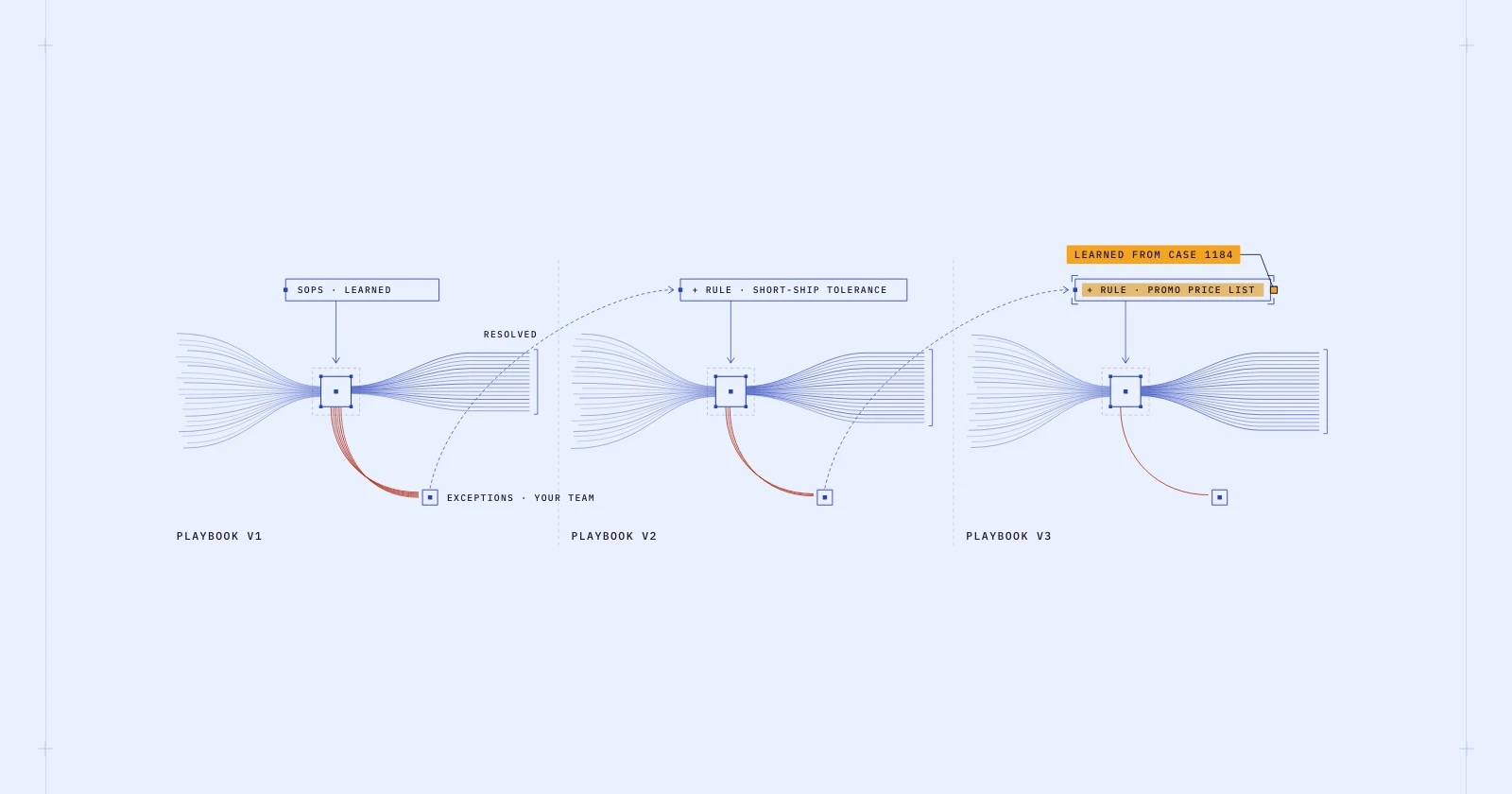
The team sets the governance. Agents learn the process from the company's SOPs, files, email and ERP history. Rules, approval limits, thresholds and escalation paths are set by the team, versioned and auditable. Every case keeps a full evidence trail. When an agent cannot resolve a case, the team gets it with the evidence attached, and the resolution becomes a rule so the same exception does not come back.
cloudsquid works on top of the existing ERP (SAP, Oracle NetSuite, Microsoft Dynamics 365, Workday, Infor), and people keep working in Outlook, Teams or the cloudsquid workspace. There is no integration project to start: the team forwards the mailbox and shares SOPs, sample cases and an ERP export, and agents work the inbox in week 2. cloudsquid is ISO 27001:2022 certified with EU data residency. It is not a close management suite: for a close checklist, consolidation or treasury, look at HighRadius, BlackLine or your ERP vendor.
Who cloudsquid is built for:
Finance and operations teams at manufacturers, distributors, wholesalers and consumer goods companies whose work arrives as email and documents across more than one process, and who want agents to close cases under their own rules and approval limits.
2. HighRadius: Agentic AI Suite for the Enterprise Office of the CFO
HighRadius sells a single platform for the office of the CFO: order to cash (collections, cash application, deductions, credit, e-invoicing), accounts payable, B2B payments, close and reconciliation, consolidation and treasury. The company states that more than 190 AI agents run on that platform and describes its approach as end-to-end process orchestration, as opposed to a marketplace of siloed agents.
HighRadius sits on the agent side and the platform side. The agents work inside HighRadius applications, so the buyer is choosing a suite as well as an agent layer.
Key capabilities:
- Order to cash agents: Credit risk scoring, blocked order release, remittance capture, payment-to-invoice matching and dunning emails.
- Deductions: A deductions validity predictor and trade promotion matching, which matter to consumer goods suppliers.
- Accounts payable: Email invoice capture, duplicate and fraud checks, 3-way matching and non-PO GL coding.
- Close and treasury: Anomaly detection, journal posting, balance sheet reconciliation and cash forecasting.
- ERP integration: Integrations for SAP, Oracle, Microsoft Dynamics and NetSuite.
HighRadius's standout capability: Outcome-based pricing
HighRadius publishes an outcome-based pricing model: no implementation fees, no fees until go-live, and a gain share after go-live tied to KPI improvements agreed in advance. It advertises guaranteed improvements such as a 10% reduction in DSO.
Who HighRadius is built for:
Large enterprises and mid-sized organizations; the company states that more than 1,500 finance teams use it. It fits a CFO who wants receivables, payables, close and treasury on one vendor's applications.
3. Esker: Governed Agents Across Source-to-Pay and Order-to-Cash
Esker, founded in Lyon in 1985, is a cloud automation suite for the office of the CFO. It covers source-to-pay (procurement, accounts payable, supplier management) and order-to-cash (order management, claims, credit, cash application, deductions, collections). The company left the stock market in 2025 after a tender offer by Bridgepoint and General Atlantic.
In September 2026 Esker announced the Synergy Agentic Framework, which it describes as a governed agentic layer built on its source-to-pay and order-to-cash solutions. That places Esker on the agent side and the platform side, with agents working within Esker's own applications.
Key capabilities:
- Business Agents: According to Esker, they can identify invoice exceptions, route approvals, prioritize collections, assess credit risk, support cash application and resolve claims.
- Conversational Finance: Users state what they need in natural language, and the platform comes back to them when an approval or confirmation is required.
- Governance: Esker states that identity, permissions, policies, approval boundaries and auditability govern how and when agents can act.
- ERP and e-invoicing: The company states it integrates with more than 70 ERP solutions, and it offers e-invoicing for France, Italy and Spain as well as EDI.
Esker's standout capability: One suite for supplier and customer documents
Esker covers source-to-pay and order-to-cash on one cloud platform, with the same AI engine, Synergy AI, underneath. A manufacturer can run supplier invoices, customer orders and claims through one vendor.
Who Esker is built for:
Companies from mid-market to multinational that want document-heavy processes automated on top of the ERP they have. Esker states that more than 3,000 businesses use it and that its software is not designed to replace ERPs.
4. SAP Joule: Assistants and Agents Inside the SAP Suite
Joule is what SAP calls its portfolio-wide AI engagement layer. Three parts matter to a finance buyer. Joule Assistants use role and process context to coordinate agents. Joule Agents, in SAP's words, execute multistep tasks across SAP and non-SAP systems. Joule Studio is where teams build custom agents with low-code or pro-code tools.
Joule sits on both sides of the first distinction: the assistant answers and guides, the agents execute. It is a platform that lives inside SAP's applications. SAP's AI release highlights for Q3 2026 describe general availability as underway in a phased approach for most finance assistants, so check what is live for your release.
Key capabilities:
- Accounts Receivable Assistant: Seven agents for account analysis, collection call preparation, collections email outreach, and dispute creation and resolution.
- Financial Closing Assistant: Agents for journal entries, accruals, and receivables and payables clearing.
- Accounts Payable and Invoicing Assistants: Payment inquiry handling, clearing proposals, and invoice processing from receipt to payment scheduling.
- Sales Operations Assistant: Creates sales orders from unstructured data and resolves billing, credit, delivery and supply blocks.
SAP Joule's standout capability: Agents inside the system of record
Joule's agents run where the master data, authorizations and postings already live. SAP states that agents can only execute what the end user has permission to do, that high-risk processes always require explicit approval, and that all agent activity is logged and traceable.
Who SAP Joule is built for:
Companies that run finance and supply chain on SAP and want agents from their ERP vendor. If much of the work arrives in a shared mailbox or as PDFs, ask how each assistant picks up that work in your landscape.
5. Microsoft Finance Agent: A Copilot for Excel and Outlook
Microsoft's finance offering launched as Microsoft Copilot for Finance, became the Finance solution in Microsoft 365 Copilot, and is now called Finance Agent in Microsoft's documentation. It brings ERP-connected data into Excel, Outlook and Copilot chat.
On the first distinction it sits closest to the copilot side. In Microsoft's description it identifies, suggests and drafts, and the finance professional reviews, confirms and sends.
Key capabilities:
- Financial reconciliation in Excel: Identifies unmatched transactions, suggests next steps and creates a reconciliation report. A saved template can rerun the same steps on a schedule.
- Collections in Outlook: Brings customer data from the ERP into Outlook, helps draft replies and saves communication summaries.
- Variance analysis: Explains the drivers of change and creates draft narratives for review.
- Copilot chat: A preview experience for natural-language questions about accounts payable and receivable, plus some ERP actions.
- ERP connections: Dynamics 365 Finance, Business Central and SAP for the Outlook add-in, according to Microsoft's deployment guide.
Microsoft Finance Agent's standout capability: It works where finance already works
Reconciliations already happen in Excel and customer emails already arrive in Outlook. Microsoft states that deployment runs within the existing Microsoft 365 tenant, with no new infrastructure to provision.
Who Microsoft Finance Agent is built for:
Finance teams in organizations licensed for Microsoft 365 Copilot, especially on Dynamics 365 Finance. European buyers should note that Microsoft's documentation currently lists US English as the only supported language for agent-created content and the interface.
6. BlackLine: Verity AI Agents for the Close and Invoice-to-Cash
BlackLine's products cover the financial close (account reconciliations, transaction matching, journal entries, consolidation), intercompany and invoice-to-cash. It now calls itself the Agentic Financial Operations Platform. Verity AI is the layer of agents embedded in it, which BlackLine describes as a suite of specialized AI agents built for finance and accounting.
BlackLine sits on the agent side with a firm position on approval: it says the team retains the authority to approve every action. It is a platform for the accounting side of the house.
Key capabilities:
- Verity Accruals: Gathers data from source systems, emails vendors to confirm amounts, calculates proposed accruals and drafts journal entries.
- Verity Prepare: Analyzes accounts, retrieves supporting documentation and drafts reconciling items for final review and approval.
- Verity Collect and Verity Remit: Customer outreach on outstanding invoices, and extraction of remittance data for cash application.
- Verity Match and Verity Flux: AI-suggested matches for complex transaction matching, and transaction-level explanations of why balances changed.
BlackLine's standout capability: Auditability as the design principle
BlackLine argues that probabilistic AI alone is a liability in accounting, so Verity pairs agents with deterministic controls and a full audit trail for every action. The company states that Verity Accruals can reduce manual work by up to 80%.
Who BlackLine is built for:
Controllers and accounting teams whose first problem is the close calendar and the reconciliations behind it. BlackLine also offers Smart Close for SAP.
7. Vic.ai: Point Agents for Accounts Payable
Vic.ai calls itself the leading AI platform for accounts payable. The core product, APSuite, covers invoice processing, PO matching and approvals. Around it sit VicInbox (an agent-powered AP inbox called Victoria), VicPay for bill pay and VicCard for expenses.
Its VicAgents are task-specific agents that, in the company's words, do not just assist but act. Vic.ai is a clear example of a point agent that goes deep in one process.
Key capabilities:
- Autonomous invoice processing: AI classifies invoices, applies GL codes and auto-matches POs within tolerance levels.
- Inbox agent: Categorizes incoming AP emails by intent and urgency, drafts replies and flags account changes, duplicates and exceptions.
- Contracts and analytics agents: Monitor invoices against contract terms and answer plain-English questions about AP data. Vic.ai lists both as beta.
- ERP integration: An open API plus prebuilt integrations, including Oracle and Microsoft suites; approved invoices post back to the ERP with audit trails.
Vic.ai's standout capability: No-touch invoice processing
Vic.ai measures itself on invoices that go through without a person. The company states an 85% no-touch rate by month six, a 99% invoice accuracy rate and a payback period of seven months.
Who Vic.ai is built for:
CFOs, controllers and AP managers whose main problem is supplier invoice volume. Vic.ai has industry pages for freight and logistics, construction, manufacturing and retail.
8. Stuut: An AI Coworker for Accounts Receivable
Stuut describes itself as an AR coworker for order-to-cash. Its site announces a $52.5M Series B led by Insight Partners. In the company's words, the agent emails, texts and calls customers, logs into portals and applies cash.
Stuut is an agent, and today a point agent for receivables. The site lists order management and credit as coming soon.
Key capabilities:
- Collections: Reaches out before invoices are overdue, finds the right billing contacts and follows up across email, SMS and voice.
- Cash application: Matches payments to the correct invoices in the ERP.
- Disputes and deductions: Identifies, investigates and resolves disputes and deductions, and determines which claims are valid.
- Controls: Stuut says it works inside the customer's systems and controls, asks before doing anything new and logs every action.
Stuut's standout capability: The agent does the outreach itself
The agent takes the next action on thousands of invoices at once, around the clock. The company states that more than $4B has moved through Stuut, reports a 47% reduction in DSO and says customers are live in weeks.
Who Stuut is built for:
AR and credit teams at larger companies with more customers and open invoices than their collectors can reach.
9. UiPath: A Platform for Building Your Own Finance Agents
UiPath's platform combines robotic process automation (RPA), intelligent document processing, AI agents and orchestration. Its line for finance is agents, robots and people on one governed platform, running above the ERP.
UiPath is the build option on this list. It offers finance solutions for purchase-to-pay, order-to-cash and invoice processing, but the platform itself is a toolkit: a company's automation team configures agents in Agent Builder and orchestrates them with Maestro.
Key capabilities:
- Agent Builder: A drag-and-drop canvas in UiPath Studio for configuring agents, with starter templates.
- Maestro: Orchestrates each step with audit trails, SLA tracking and human-in-the-loop oversight.
- Invoice processing: Ingests invoices from email, PDF, supplier portal and EDI, matches them to PO and goods receipt and routes exceptions to accounts payable.
- ERP independence: UiPath states it works on top of SAP, Oracle, NetSuite, Workday and Coupa, and that the ERP stays the system of record.
UiPath's standout capability: One governed platform for agents, robots and people
UiPath says every decision runs inside its AI Trust Layer, with audit-ready logs and human review for cases above defined thresholds. For a company that already runs UiPath robots, agents extend an automation estate it knows.
Who UiPath is built for:
Enterprises with an automation team or implementation partner that want to design their own agents across finance and other departments, and can build, test and maintain them.
How to Choose the Right AI Agents for Finance Operations
The nine tools solve different problems. Answer these questions before you book demos.
1. Do you want help doing the work, or do you want the work done?
A copilot keeps the person in every step. Microsoft Finance Agent and the assistant side of SAP Joule fit a team that wants faster analysis and better drafts. For fewer cases on the team's desk, look at agents that close work under rules: cloudsquid, HighRadius, Esker, BlackLine, Vic.ai and Stuut. In a demo, ask who performs the final action in the ERP, and under which approval limit.
2. Is the problem one process or several?
For one process, a point agent goes deep: Vic.ai for supplier invoices, Stuut for collections, BlackLine for the close. If orders, claims, carrier invoices, deductions and supplier invoices all arrive in the same week, a platform avoids a new vendor and a new audit trail per process. cloudsquid, HighRadius and Esker cover several processes with one layer.
3. Where does the work arrive?
Work that starts as a transaction inside the ERP suits ERP-native agents such as SAP Joule and close platforms such as BlackLine. Work that starts as an email, a PDF, a portal download or a spreadsheet needs an agent that reads the inbox first. That is the design of cloudsquid, and of VicInbox for the AP mailbox.
4. Which ERP do you run, and how many?
On a single SAP landscape, Joule is the natural first look. On Dynamics 365 Finance, start with Microsoft Finance Agent. Companies with several ERPs, often after acquisitions, should prefer tools that sit on top of the ERP: cloudsquid, Esker, HighRadius and UiPath.
5. Do you want to buy agents or build them?
UiPath and Joule Studio let a company build its own agents. That gives control over every step and makes the company responsible for design, testing and maintenance. We cover that trade-off in our memo on building it yourself. Without an automation team to own the build, buy agents and let your team set the rules.
What Good AI Agents for Finance Operations Look Like in Practice
Take one message. A retailer's remittance arrives with a short pay and a deduction code. With a copilot, the analyst gets a summary and a drafted reply, then still finds the invoice, the promotion agreement and the proof of delivery, decides whether the deduction is valid and posts the result.
With an agent, the payment is matched to the open invoices, the deduction is checked against the agreement and the delivery record, the valid part is posted and the invalid part is disputed with the documents attached. The analyst sees only the case the agent could not settle.
Good agents work under written rules. Approval limits, thresholds and escalation paths are set by the finance team, and every change is versioned. Each case leaves a trail: what came in, which records it was checked against, what was posted, who approved.
Exceptions should shrink over time. When a person resolves a case, the resolution becomes a rule, so the same question does not return next month.
If your shared mailbox looks like the one at the top of this post, book a demo and we will show you how cloudsquid would work it.
Frequently Asked Questions
What is an AI agent for finance operations? It is software that takes a task, such as a customer order, a supplier invoice or a remittance, and works it through several steps to a result in the ERP. It reads the document, checks it against company records, acts within set rules and approval limits, and records what it did. We describe the mechanics in how AI agents can solve complex finance tasks.
What is the difference between a finance copilot and a finance agent? A copilot answers questions and drafts, and the person performs each step and the final action. An agent performs the steps itself and involves a person at defined points, for example above an approval limit. Many products contain both, so ask which tasks run without a person.
Can AI agents post to the ERP on their own? Yes, where the company allows it. Vendors differ on the default: SAP states that high-risk processes always require explicit approval, BlackLine keeps approval authority with the team, and cloudsquid lets the team decide what agents may do alone.
Do AI agents for finance work with SAP, Oracle NetSuite and Microsoft Dynamics 365? Most do, in different ways. ERP-native agents such as SAP Joule run inside one vendor's applications. Independent tools such as cloudsquid, Esker, HighRadius and UiPath connect to several ERPs and leave the ERP as the system of record.
How long does it take to implement AI agents for finance? It depends on how much integration comes first. Stuut says customers are live in weeks, and BlackLine says most teams start to see benefits within weeks. cloudsquid is live in two weeks, because the team starts by forwarding a mailbox and sharing SOPs, sample cases and an ERP export.
What is the ROI of AI agents for accounts receivable and accounts payable? The drivers are recovered money and released time: invalid deductions disputed, duplicate invoices and freight billing errors caught, cash applied sooner, fewer hours of manual entry. Vendors publish their own figures, so ask for a baseline measured on your data.
Should we use the agents in our ERP or add a separate agent layer? Use the ERP's agents for work that begins and ends inside the ERP. Add a separate layer when the work begins outside it, in email, documents, portals and spreadsheets, or spans several systems. Many companies will run both.
Related Comparisons
Über den Autor
Co-founder & CPO, Cloudsquid
Filip Rejmus, co-founder and Chief Product Officer at cloudsquid, is building infrastructure to help companies manage, scale, and optimize AI workflows. With a background spanning software engineering, data automation, and product strategy, he bridges the gap between AI research and building useful, friendly Products.Before founding Cloudsquid, Filip worked in engineering and data roles at Taktile, SoundHound, and Uber, and contributed to open-source projects through Google Summer of Code. He studied Computer Science at TU Berlin with additional coursework in Quantitative Finance at TU Delft and Computer Graphics at UC Santa Barbara.
Weiterlesen
Weitere Beiträge für Ihr Team.
Finance Operations 17 Min. Lesezeit
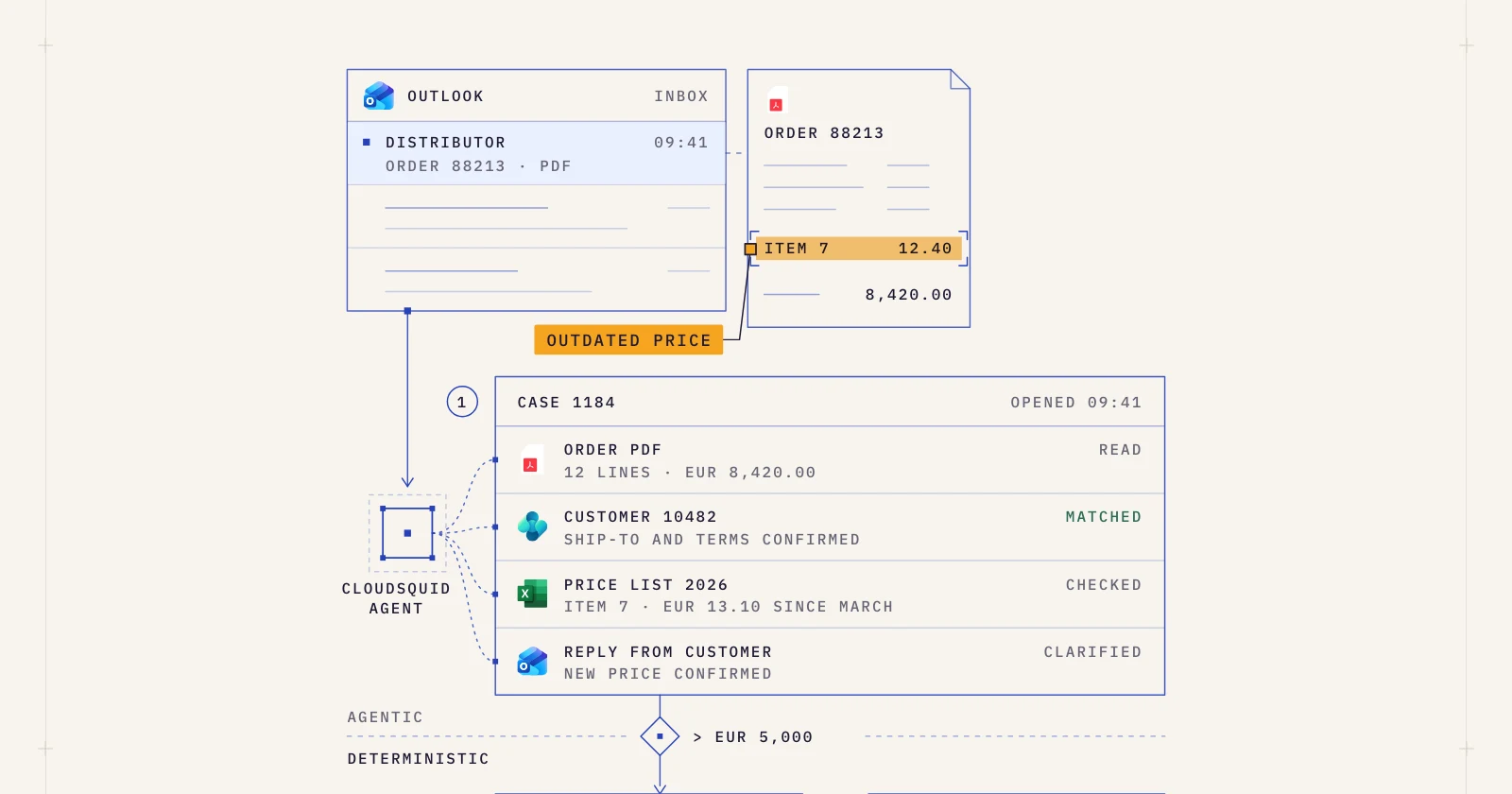
9 Best Sales Order Automation Software Tools for 2026
Artikel lesen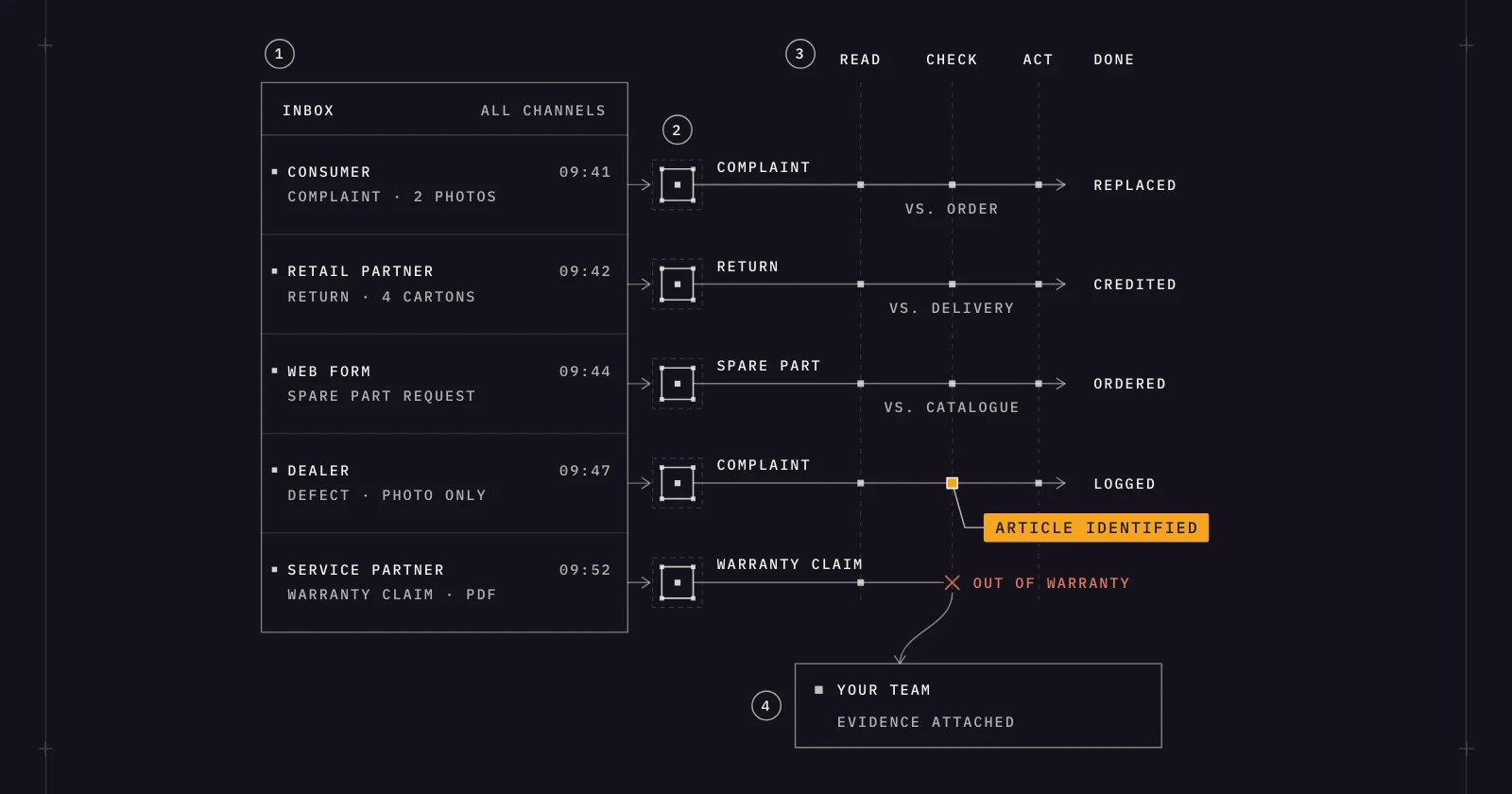
Finance Operations 17 Min. Lesezeit
9 Best B2B Customer Service Automation Tools for Manufacturers and Distributors in 2026
Artikel lesen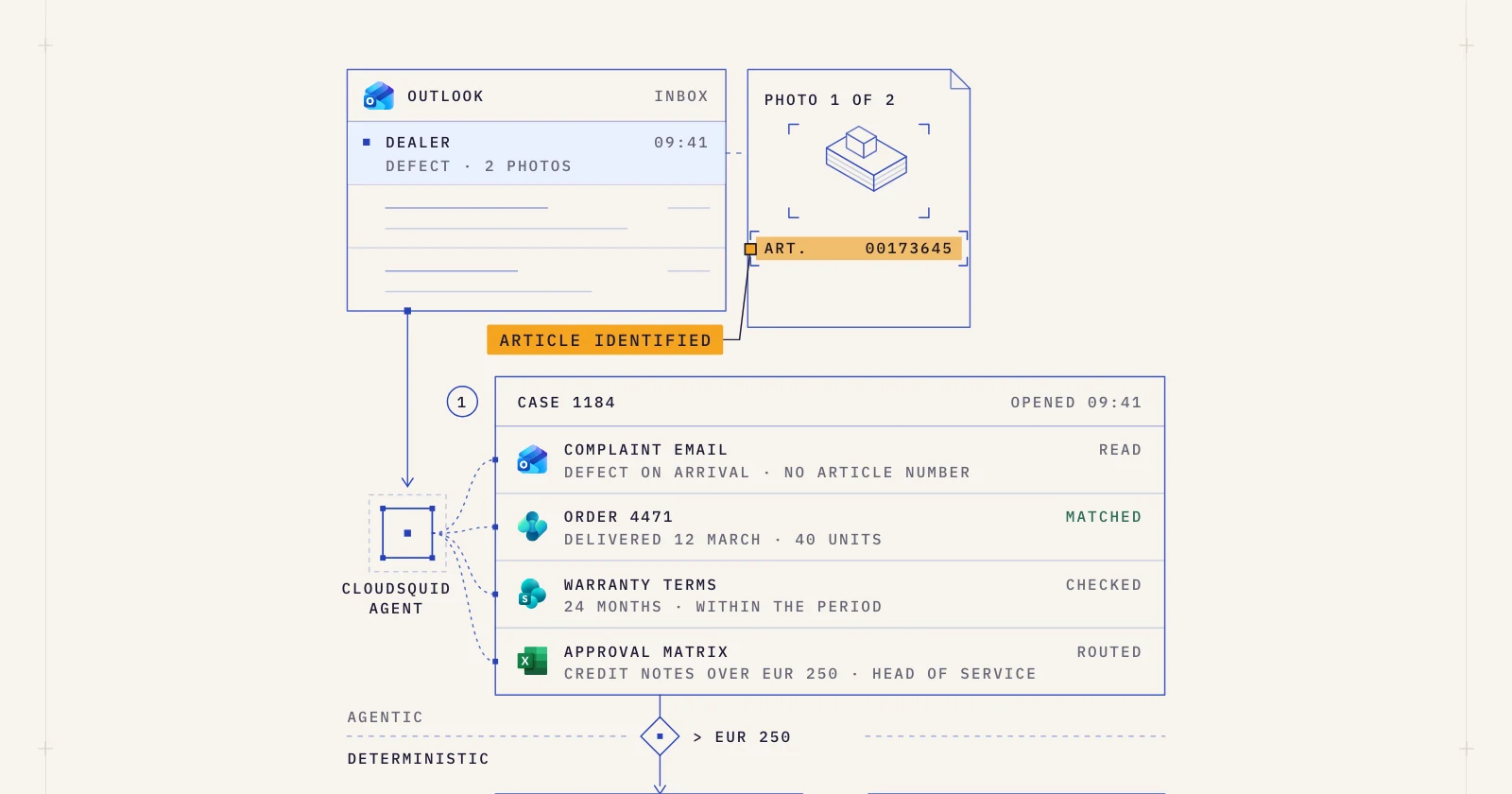
Finance Operations 17 Min. Lesezeit
9 Best Returns and Warranty Claims Management Software Tools for 2026
Artikel lesenNächster Schritt
Automatisieren Sie den Workflow hinter diesem Artikel.
Bringen Sie Ihre Dateien und Regeln mit. Cloudsquid setzt daraus in wenigen Wochen einen prüfbaren KI-Workflow um.