
Finance Operations
9 Best Cash Application Software Tools for 2026
Compare the 9 best cash application software tools for 2026: matching engines for clean payments, AI agents for the unapplied cash that remains.
- Von
-
 Filip Rejmus
- Veröffentlicht
- Lesezeit
- 17 Min. Lesezeit
The wire is on this morning's bank statement: $184,312.40 from one of your largest customers. No remittance advice came with it. The open items on the account do not add up to that amount in any combination. The payment goes on account, the invoices keep aging, and collections sends a reminder to a customer who has already paid.
That is unapplied cash, and the easy payments rarely cause it. One payment, one invoice, remittance attached: a matching engine auto-applies those all day. What keeps cash unapplied is the remainder. Remittance advice that arrives late or never. One payment that covers sixty invoices. Short pays and deductions. Remittances that sit in a customer portal or are typed into an email body. Questions that have to go back to the customer.
Most cash application software is built around the first group and sold on its match rate. A newer kind of tool puts agents on the second group, and several established suites now ship agents of their own. Which one you need depends on where your unapplied cash comes from.
This post covers the best cash application software for 2026: what each tool does, who it is built for, and where it sits between matching the clean payments and working the remainder.
Best Cash Application Software at a Glance
| Tool | Best for | Standout |
|---|---|---|
| cloudsquid | AR teams whose unapplied cash comes from the mailbox: late or messy remittance advice, short pays, customer questions | Agents read remittance advice from emails, PDFs and portals, match it to open items and apply payments in the ERP |
| HighRadius | Enterprise and mid-market AR teams with high payment volumes across banks and ERPs | 13 AI agents from remittance capture to deductions coding and ERP posting |
| Billtrust | Companies that want cash application inside a wider invoicing, payments and collections platform | Confidence-based matching with a threshold the team can adjust |
| Esker | Large companies with complex receivables, often on SAP or several ERPs | Deduction details in the remittance trigger the deductions workflow |
| Versapay | Finance teams on NetSuite, Sage Intacct or Dynamics 365 | Payments made through its own portal arrive already matched to invoices |
| BlackLine | Accounting teams that want cash application next to close and reconciliation | Pre-built application rules and Verity AI on one finance platform |
| Serrala | SAP-centric enterprises, plus teams on other ERPs through its cloud version | Runs natively inside SAP S/4HANA, with an agent for unmatched payments |
| SAP Cash Application | SAP S/4HANA Cloud users who want matching inside SAP | Machine learning trained on the company's own past clearing decisions |
| Emagia | Global enterprises with many banks, currencies and ERPs | Gia, an AI copilot that contacts customers to collect remittance information |
1. cloudsquid: AI Agents for the AR Mailbox
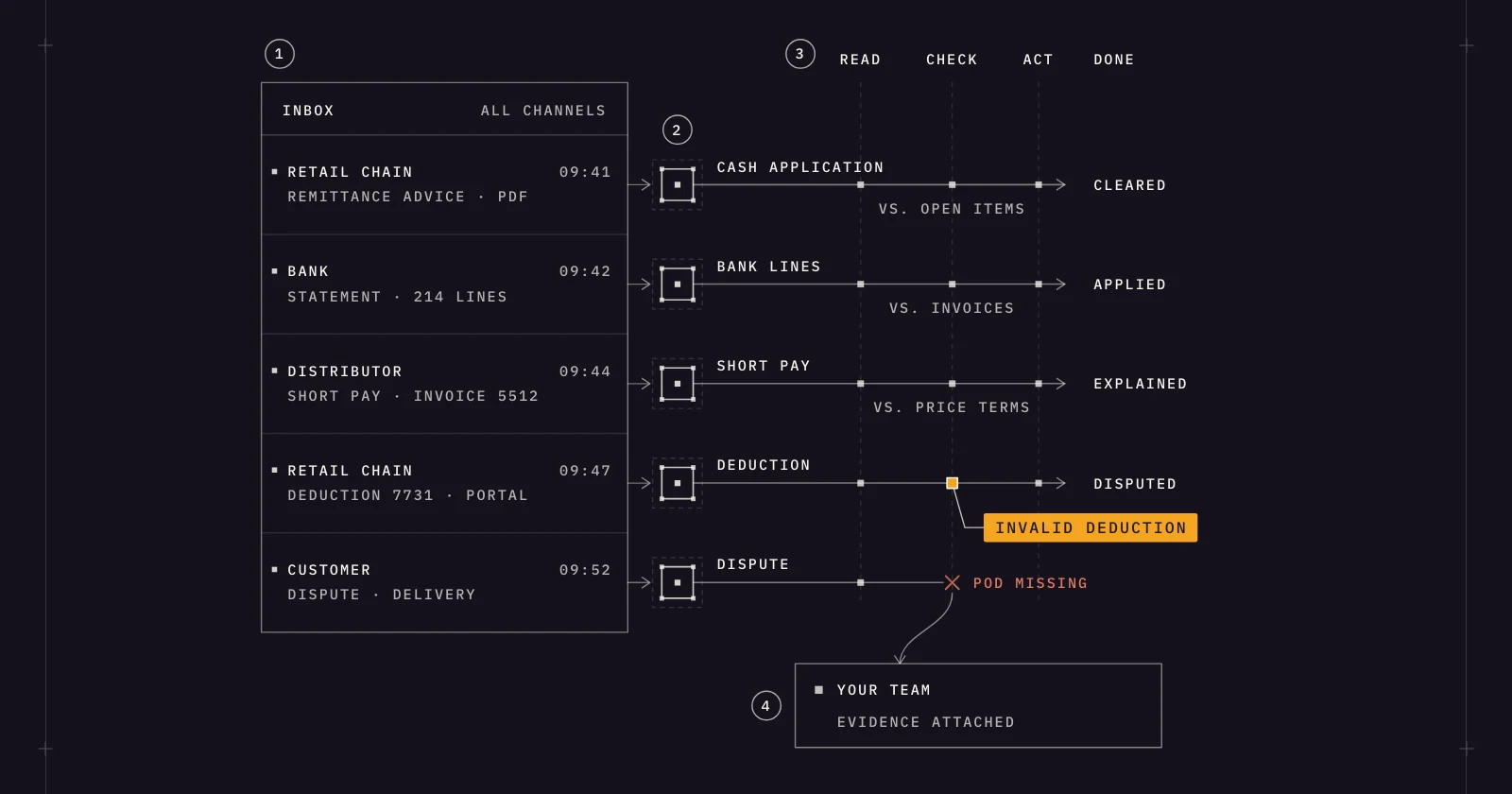
Most cash application software starts at the bank file. cloudsquid starts at the AR mailbox, because that is where the remainder lives: the remittance advice that came a day after the wire, the PDF that lists 140 invoices and six deductions, the email that says "paying invoices 4471 to 4480 less the pallet claim," the remittance that only exists in a customer's portal.
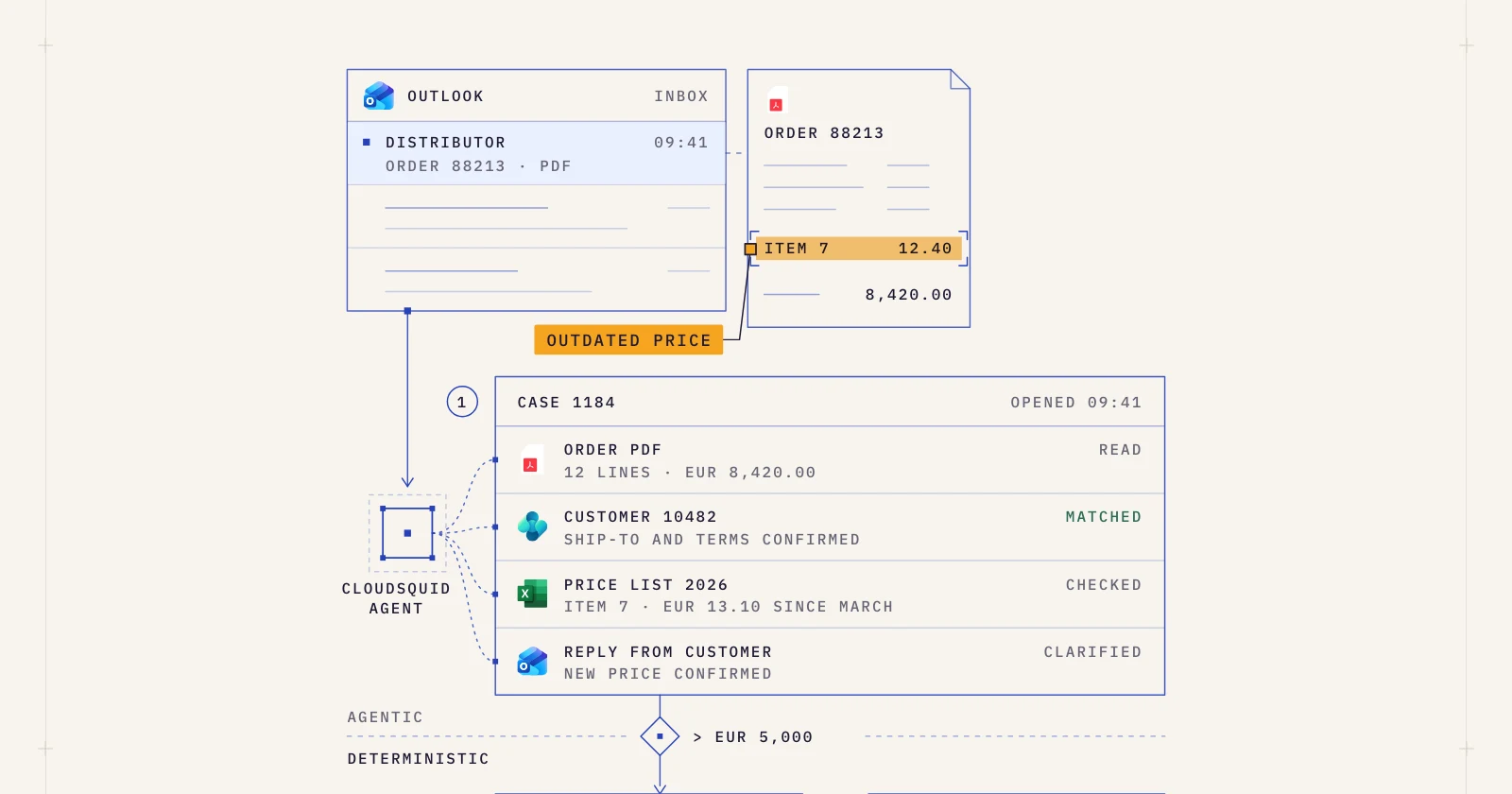
cloudsquid is an autonomous inbox for finance and operations teams at companies that make, move and sell physical products. Every message in the AR mailbox becomes a task with its own agent. The agent reads the remittance advice from the email, PDF or portal, matches it to the open items in your ERP and applies the payment there. Short pays are separated into deductions to check. Cases that need a person arrive with the evidence attached.
cloudsquid is not a lockbox service, a payment portal or a credit and collections suite. If nearly all of your payments arrive with structured remittance and the problem is matching volume, the engines below are the tools to look at. cloudsquid is the agent layer for the work that ends up in a person's inbox.
What makes cloudsquid different for cash application:
Agents learn the process from your SOPs, files, email and ERP history. Rules, thresholds, approval limits and escalation paths are set by your team, versioned and auditable, and the team decides what agents may do alone. Every case keeps a full evidence trail. When an agent cannot resolve a case, the team gets it with the evidence attached, and the resolution becomes a rule so the same exception does not come back.
cloudsquid works on top of the ERP you already run (SAP, Oracle NetSuite, Microsoft Dynamics 365, Workday, Infor), and people keep working in Outlook, Teams or the cloudsquid workspace. There is no integration project to start: the team forwards the mailbox and shares SOPs, sample cases and an ERP export on day one, and agents work the inbox in week two. cloudsquid is ISO 27001:2022 certified with EU data residency.
One published result: a diversified industrial manufacturer cleared $2M of working capital from unapplied cash (more in the customer results). Short pays lead straight into deductions, and a team that starts with remittances can add the rest of order to cash without buying another tool.
Who cloudsquid is built for:
AR teams at manufacturers, distributors and consumer goods companies where the ERP's own rules or a matching engine already clear the easy payments, and analysts still spend their days chasing remittance advice, keying multi-invoice remittances, sorting short pays and logging in to customer portals. The cash application page shows the process.
2. HighRadius: Autonomous Cash Application at Enterprise Volume
HighRadius sells its cash application product to enterprise and mid-market AR teams and organizes it around what the company calls 13 AI agents, each responsible for a step between the bank statement and the posted payment. The headline claim on its site is 90%+ straight-through cash posting.
The product reaches into the remainder as well. According to HighRadius, its agents retrieve remittances from more than 500 customer AP portals and use learned payment patterns to predict a missing remittance.
Key capabilities:
- Email remittance capture: Reads remittance data from email attachments (PDF, Word, Excel) and from the email body.
- Payment invoice matching: Matches on full or partial references such as invoice or PO numbers and can split payments.
- Exception handler: Assigns exception payments to analyst worklists with recommended customers and remittances.
- Deductions coding: Identifies why a customer short-paid and maps the reason to the reason codes defined in the ERP.
- ERP payment posting: Posts payments through pre-built connectors for SAP, Oracle, NetSuite and Dynamics 365, including clearing from a late remittance.
HighRadius's standout capability: An agent for each step of the flow
HighRadius breaks cash application into narrow agents, from bank statement download to deductions coding, so each step can be measured and tuned on its own. For enterprises processing millions of payment line items, the company states item-level automation of 90%+.
Who HighRadius is built for:
Enterprises and mid-market companies with high payment volumes across several banks, ERPs and business units, where the goal is a measurable straight-through rate across the whole process.
3. Billtrust: Confidence-Based Matching Inside an AR Platform
Billtrust offers cash application as one part of an accounts receivable platform that also covers invoicing, payments, credit and collections.
The matching approach is the distinctive part. Billtrust describes it as "not rule-based, confidence-based": the engine scores how likely each match is to be correct, and the team raises or lowers the threshold to control how many payments are flagged for manual follow-up.
Key capabilities:
- Confidence-based matching: Scores each candidate match with machine learning and learns from the exceptions the team resolves.
- Remittance capture: Captures remittance data from email, portal downloads, EDI and paper, according to the company.
- Match Review: A dedicated feature where analysts resolve the flagged payments.
- Payment coverage: Processes ACH, wire, credit card, check and AP portal payments.
Billtrust's standout capability: A dial instead of a rule book
Rule-based matching needs someone to maintain the rules as customers change how they pay. A confidence score leaves the team with one decision: how sure is sure enough. Billtrust states cash application match rates of 95%+ on its site.
Who Billtrust is built for:
Companies that want cash application from the same vendor that delivers their invoices and takes their payments. Billtrust names distribution, manufacturing, equipment and transportation among its industries.
4. Esker: Cash Application Tied to the Deductions Workflow
Esker, founded in Lyon, France in 1985, sells automation for order-to-cash and source-to-pay processes. Its cash application product can be deployed alone or bundled with Esker's Accounts Receivable suite. The company says it is built for large companies and complex receivables environments.
Matching is driven by Esker Synergy AI. When remittance is missing or incomplete, Esker says Synergy AI uses fields in the payment file, such as customer names and invoice numbers, to suggest likely matches. Accuracy improves over time through user validations.
Key capabilities:
- Remittance capture: Captures payment and remittance data from every channel in one workflow, in Esker's words.
- Synergy AI matching: Extracts key data and matches payments to invoices, with human-in-the-loop validation.
- Allocation options: Configurable handling for discounts, deductions, short payments, cross-company payments and multiple currencies.
- Exception workspace: A guided workspace with suggestions for payments that need review.
- ERP integration: A prebuilt SAP connector with real-time reconciliation, and flat-file integration for any other ERP, including multi-ERP environments.
Esker's standout capability: Deductions start at the remittance
Esker extracts deduction information from the remittance and triggers the deductions workflow. For suppliers whose customers deduct on almost every payment, that removes a handoff between the cash team and the deductions team. The company cites an 80%+ reduction in open deductions and a 95%+ reduction in month-end unapplied cash.
Who Esker is built for:
Large companies with several ERPs or heavy deduction volume. Esker also sells collections, credit and deductions management, so it suits teams that plan to automate more of accounts receivable with one vendor.
5. Versapay: Cash Application for NetSuite, Sage Intacct and Dynamics 365
Versapay sells accounts receivable automation with native integrations for Oracle NetSuite, Sage Intacct and Microsoft Dynamics 365. Its cash application product matches payments from wires, ACH, checks and cards. The company states 90%+ straight-through processing.
Key capabilities:
- Multi-channel remittance capture: Reads remittances from email, PDFs, EDI files, AP portals and lockboxes, using OCR for paper.
- Machine learning matching: Built-in machine learning that, according to Versapay, gets smarter with each transaction.
- Short-pay and deduction coding: Automates routing and coding for short pays and deductions.
- Exception workflow: Routes unmatched payments to the right team member in a shared workspace.
- ERP integration: Open APIs or flat files for ERPs outside the three native integrations.
Versapay's standout capability: Payments that arrive already matched
Online payments made through Versapay's cloud-based payment portal are matched automatically to invoices. The more customers pay through the portal, the fewer remittances there are to interpret at all. For everything else, the product works alongside existing bank lockboxes.
Who Versapay is built for:
Finance teams on NetSuite, Sage Intacct or Dynamics 365 that want cash application together with a customer payment portal. Versapay lists manufacturing and wholesale distribution among the industries it serves.
6. BlackLine: Cash Application Next to the Close
BlackLine's platform covers financial close, intercompany and invoice-to-cash. The invoice-to-cash line puts cash application alongside collections management, credit and risk management, and disputes and deductions management.
Cash Application uses auto-application rules, intelligent data capture and text recognition to pull remittance data from different sources and apply payments to invoices in the ERP. BlackLine says its machine learning and pre-built logic apply payments even when a customer sends no reference information or remittance.
Key capabilities:
- Pre-built application rules: Rules that BlackLine says come from years of work with customers across hundreds of industries.
- Payment pattern learning: The AI learns customer payment patterns over time, according to the company.
- Verity AI: BlackLine's AI layer, described as built on 20+ years of finance and accounting process knowledge.
- ERP integration: Works with SAP, Oracle and other ERPs. The company says it integrates with nearly all ERP systems.
BlackLine's standout capability: Cash application on the close platform
Unapplied cash is also a reconciliation problem: it sits in a clearing account that someone has to explain at month end. BlackLine puts cash application on the same platform as account reconciliations and transaction matching.
Who BlackLine is built for:
Accounting-led organizations that want accounts receivable and record-to-report on one platform, often with BlackLine already in place for the close, and teams running SAP or Oracle.
7. Serrala: SAP-Embedded and Cloud Cash Application
Serrala, with offices in Norderstedt, Germany and Chicago, offers cash application in two forms. Cash Application SAP Embedded runs natively inside SAP S/4HANA and is described as clean-core compliant. Cash Application Cloud is aimed at mid-market to enterprise teams on ERPs such as NetSuite, Microsoft Dynamics, IFS, Sage, Infor, Epicor and SAP S/4HANA Public Cloud.
Both follow the same sequence. Rule-based automation runs first. An unmatched payment resolution agent then takes the payments the rules could not process.
Key capabilities:
- Automated allocation: Serrala states automation rates of up to 99% for the SAP-embedded version and up to 98% for the cloud version.
- Unmatched payment resolution agent: Ranks candidate matches using reference numbers, customer context, aging logic and similar historical allocations.
- Capture AR add-on: AI-powered remittance capture across channels, offered as an add-on.
- SAP coverage: Supports S/4HANA Public Cloud, Private Cloud and on-premise, plus SAP ECC.
Serrala's standout capability: An agent that explains its proposals
For payments the rules miss, the agent returns allocation recommendations with a confidence score and an explanation, and a person approves. Serrala says this reduces manual effort for resolutions by as much as 40%, with up to 50% of recommendations leading to direct resolution.
Who Serrala is built for:
Enterprise SAP customers with high-volume, multi-format remittances that want cash application inside their SAP landscape, including companies still on ECC. Deductions are covered by a separate Serrala product.
8. SAP Cash Application: Machine Learning Inside S/4HANA
For companies on SAP S/4HANA Cloud, the nearest option is SAP's own. SAP Cash Application is a cloud-based solution that uses machine learning to propose matches between open receivables and incoming bank statement items. Payment and open invoice data is passed from S/4HANA to a matching engine on SAP Business Technology Platform.
Key capabilities:
- Receivables line-item matching: Proposes matches between open receivables and bank statement items and clears them automatically when the confidence criteria are met.
- Trained on your history: The model is trained with data from past manual clearing actions.
- Two thresholds: One target accuracy for automatic clearing, and a second confidence level above which a proposal is shown to the accountant.
- Lockbox matching: A separate service proposes and clears matches for incoming lockbox files, usually in BAI or BAI2 format.
- Payment advices: Payment advices can be extracted and uploaded in bulk.
SAP Cash Application's standout capability: It stays inside SAP
Proposals appear in the Reprocess Bank Statement Items app that SAP accountants already use, and anything below the threshold stays there for manual post-processing. The cash team does not have to learn a second workspace.
Who SAP Cash Application is built for:
Companies on SAP S/4HANA Cloud (SAP's training material lists the Public and Private editions) that want better proposals on bank statement items without adding a vendor. Groups with several ERPs should check how the specialist tools on this list cover their non-SAP systems.
9. Emagia: AI Cash Application for Global, Multi-Bank Operations
Emagia, headquartered in Santa Clara, California, sells what it calls AI-native cash application software. Its pitch is breadth of intake. The company lists pre-built integration with over 170 global and local banks, support for BAI2, MT940, CAMT.053 and EDI formats, and a single cash application platform for multiple ERPs. It states touchless cash application of over 95%.
Key capabilities:
- Remittance capture: Captures data from cheque images, lockbox files, email remittance PDFs and bank statements in multiple languages.
- Portal retrieval: Gathers remittances from customer AP portals.
- AI and rules matching: AI and machine learning with hundreds of pre-built rules, plus predictive matching for unidentified receipts.
- Deduction auto-coding: Auto-codes deductions and aggregates remittances.
- Multi-ERP support: Names JD Edwards, SAP, Oracle, NetSuite, PeopleSoft and Microsoft Dynamics.
Emagia's standout capability: Gia asks the customer
Gia is Emagia's AI copilot, pretrained for the cash application function. Among other things, it handles automated voice, chat and email correspondence with customers to collect remittance information. That addresses the hardest case: the payment where only the customer knows what it was for.
Who Emagia is built for:
Global enterprises with many bank relationships, currencies and ERPs that want one cash application layer across all of them. The industries Emagia lists include CPG, manufacturing, logistics and medical devices.
How to Choose the Right Cash Application Software
The tools on this list solve different parts of the problem. Answer these questions about your own process before you compare vendors.
1. Where does your unapplied cash come from?
Sort last month's unapplied and on-account items by cause. If most are payments that came with usable remittance and still were not matched, you have a matching problem, and an engine with a high straight-through rate is the answer: HighRadius, Billtrust, Esker, Versapay, BlackLine, Serrala, Emagia, or SAP Cash Application if you are on S/4HANA. If most are missing or late remittance advice, portal remittances, short pays and open customer questions, you have a remainder problem. Look at agents that work the mailbox (cloudsquid) and at suites that state coverage for those cases, such as HighRadius, Emagia and Serrala.
2. How do your customers send remittance advice?
Structured remittance (EDI 820, lockbox files, references on the bank statement) suits every engine on this list. Email attachments, email bodies and customer portals are harder. Ask each vendor to process your own samples: a 300-line PDF, an email with invoice numbers typed into the body, a portal download.
3. What should happen to a short pay?
A short pay is either a deduction to check or a pricing or delivery problem to fix. Leaving it as a residual on the account hides both. Esker triggers its deductions workflow from the remittance, HighRadius maps short-pay reasons to ERP reason codes, Versapay and Emagia automate deduction coding, and cloudsquid separates short pays into deductions to check.
4. Which ERP do you post to, and how many?
SAP-centric companies should look at SAP Cash Application and Serrala's SAP-embedded version first, with Esker's SAP connector as a third option. NetSuite, Sage Intacct and Dynamics 365 users will find native integrations at Versapay. Multi-ERP groups should compare HighRadius, Esker and Emagia. cloudsquid works on top of the existing ERP and connects to SAP, Oracle NetSuite, Microsoft Dynamics 365, Workday and Infor.
5. How much change can the team take on?
A full order-to-cash suite brings credit, collections and deductions management with it. That is the right scope when the whole AR function is being rebuilt. If the easy payments already clear and the pain is the mailbox, a narrower start is faster: cloudsquid needs no integration project to begin. You can book a demo to see how it handles remittances like yours.
What Good Cash Application Looks Like in Practice
The difference shows on a single payment.
A customer wires $212,000 against 85 invoices and takes four deductions. The remittance advice arrives by email the next morning as a PDF.
With matching alone, the wire goes on account on day one because there is nothing to match it to. An analyst finds the PDF a day or two later, keys 85 lines and parks the four short pays as residuals. Collections has already sent a reminder.
With the remainder covered, the payment waits hours instead of days. The remittance is read when it arrives and linked to the wire. The 85 invoices are cleared in the ERP. The four deductions become four cases, each with the customer's stated reason. If one line refers to an invoice that does not exist, a person gets that one question with everything else already done.
In the second version the cash team does the judgment work: approving an unusual allocation, deciding whether a deduction is valid, calling the customer who never sends remittance advice.
The measures are small and visible: how much cash is unapplied at the end of the day, how old the oldest item is, and whether anyone can say why it is still there.
Frequently Asked Questions
What is cash application software? Cash application software matches incoming customer payments to open invoices and posts them to accounts receivable in the ERP. It takes payment data from the bank and remittance data from customers, applies or proposes the match, and routes what it cannot match to a person.
What is unapplied cash? Unapplied cash is money that has been received but not yet matched to specific invoices. It sits on account or in a clearing account, overstates open receivables and triggers reminders to customers who have already paid.
What is the difference between a matching engine and an AI agent in cash application? A matching engine compares payments to open items using rules or machine learning and auto-applies the ones it is confident about. An agent works a case the way an analyst would: it reads the remittance email, opens the PDF, checks the open items and separates the short pay. Most companies need both, and several suites now include agents alongside their engines.
Does cash application software work with SAP, NetSuite or Dynamics 365? Yes, but the depth differs. SAP Cash Application and Serrala's SAP-embedded product work inside the SAP environment. Versapay lists native integrations for NetSuite, Sage Intacct and Dynamics 365, and HighRadius states pre-built connectors for SAP, Oracle, NetSuite and Dynamics 365. cloudsquid works on top of the existing ERP.
What match rate should we expect from automated cash application? Several vendors on this list state straight-through or automation rates of 90% and above. The rate you get depends on how your customers send remittance advice, so ask for a test on your own payments, and ask what happens to the share that does not match.
How long does cash application automation take to implement? Scope decides it. Connecting banks, lockboxes and several ERPs takes longer than starting with one mailbox and one ERP, so ask each vendor for a timeline based on your setup. With cloudsquid the mailbox is forwarded on day one and agents work the inbox in week two.
What is the ROI of cash application automation? It comes from analyst hours no longer spent keying remittances, working capital released when cash is applied sooner, and short pays that get checked as deductions instead of written off. A diversified industrial manufacturer working with cloudsquid cleared $2M of working capital from unapplied cash.
Related Comparisons
Über den Autor
Co-founder & CPO, Cloudsquid
Filip Rejmus, co-founder and Chief Product Officer at cloudsquid, is building infrastructure to help companies manage, scale, and optimize AI workflows. With a background spanning software engineering, data automation, and product strategy, he bridges the gap between AI research and building useful, friendly Products.Before founding Cloudsquid, Filip worked in engineering and data roles at Taktile, SoundHound, and Uber, and contributed to open-source projects through Google Summer of Code. He studied Computer Science at TU Berlin with additional coursework in Quantitative Finance at TU Delft and Computer Graphics at UC Santa Barbara.
Weiterlesen
Weitere Beiträge für Ihr Team.
Finance Operations 17 Min. Lesezeit
9 Best Sales Order Automation Software Tools for 2026
Artikel lesen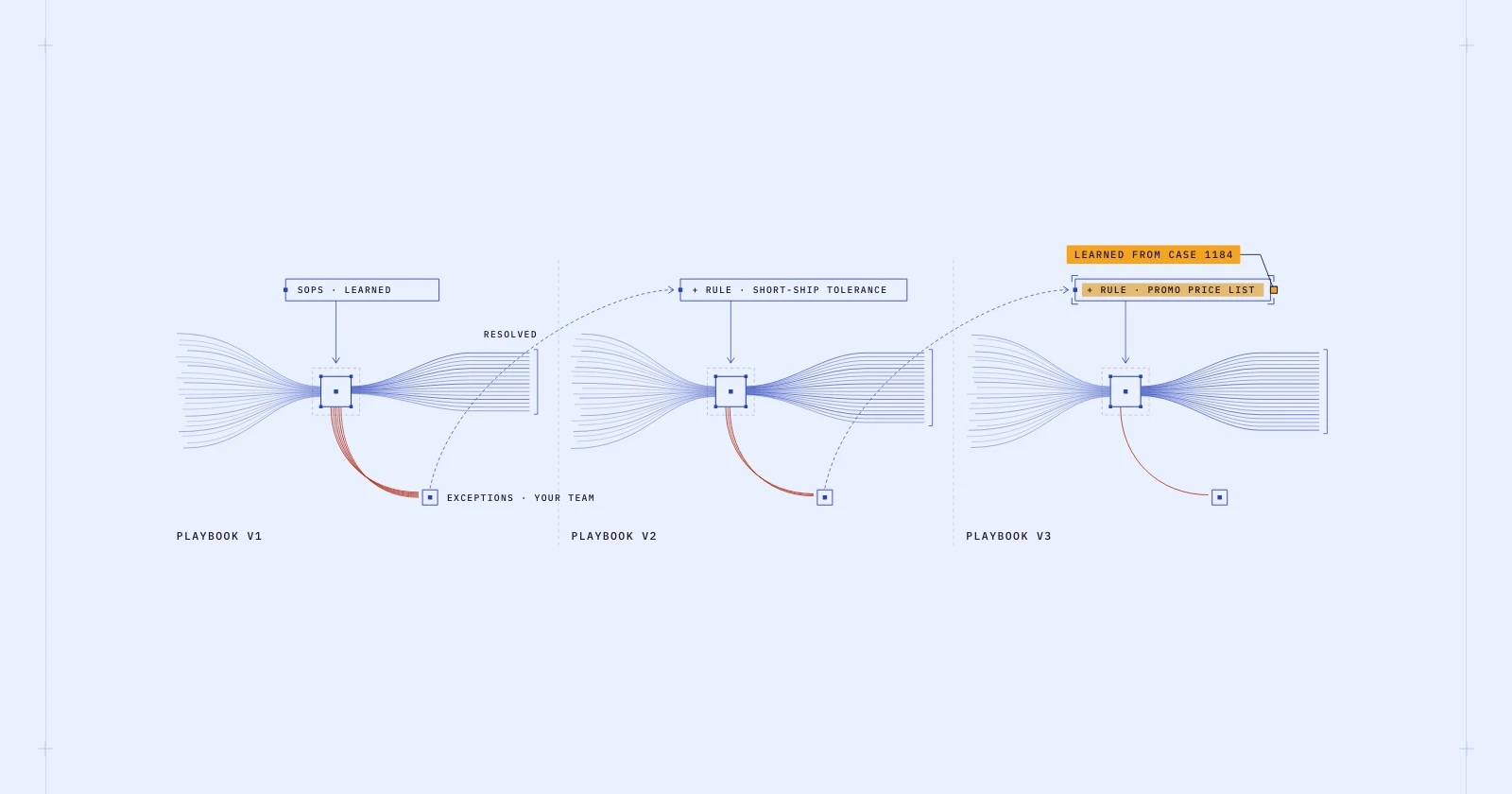
Finance Operations 17 Min. Lesezeit
9 Best AI Agents for Finance Operations in 2026
Artikel lesen
Finance Operations 17 Min. Lesezeit
9 Best B2B Customer Service Automation Tools for Manufacturers and Distributors in 2026
Artikel lesenNächster Schritt
Automatisieren Sie den Workflow hinter diesem Artikel.
Bringen Sie Ihre Dateien und Regeln mit. Cloudsquid setzt daraus in wenigen Wochen einen prüfbaren KI-Workflow um.