
Finance Operations
9 Best AP Automation Software Tools for Manufacturers and Distributors in 2026
Compare 9 AP automation software tools for manufacturers and distributors: line level PO matching, partial deliveries, SAP fit and how to choose in 2026.
- Von
-
 Filip Rejmus
- Veröffentlicht
- Lesezeit
- 17 Min. Lesezeit
The invoice bills 480 cases at $14.20. The purchase order says 500 at $13.85. The warehouse booked 460 on Tuesday and the rest is on backorder. The supplier's order confirmation, which announced the new price three weeks ago, is still sitting in a buyer's inbox. So which number does AP pay?
Most AP automation answers an easier question. It captures the invoice, writes the header data to the ERP and routes the document to an approver. That works for indirect spend and services, where someone owns the cost and can say yes or no.
Direct spend is different. Materials, components and goods for resale are bought on purchase orders, delivered in parts and billed line by line. Each line has to be checked against what was ordered, received and agreed: the purchase order, the goods receipt, the contract or price list, the supplier's order confirmation, the freight terms. Manufacturers and distributors live with partial deliveries, price changes, units of measure and over and under deliveries. That is where generic AP automation leaves the work with the clerk.
This post covers the best AP automation software for manufacturers and distributors in 2026: what each tool does with a PO invoice, who it is built for, and where it sits between routing invoices and checking them at line level.
Best AP Automation Software for Manufacturers and Distributors at a Glance
| Tool | Best for | Standout |
|---|---|---|
| cloudsquid | Manufacturers and distributors that still check supplier invoices by hand | AI agents match each invoice line against PO, goods receipt, agreed price and order confirmation; only exceptions reach the team |
| Medius | Manufacturers and distributors with goods-based PO spend | Line-level matching that holds invoices for partial receipts and backorders |
| Basware | Global groups with shared service centers and several ERPs | Line and header matching across POs, receipts and contracts; e-invoicing compliance in 60+ countries |
| Esker | Large companies that want payables and receivables on one platform | Three-way matching with Esker Synergy AI for capture and coding |
| OpenText Vendor Invoice Management | Companies running SAP ECC or SAP S/4HANA | Invoices, order confirmations and delivery notes processed inside SAP |
| xSuite | SAP customers that want a certified, embedded invoice workflow | Touchless posting on a 3-way match, plus order confirmation processing |
| Tungsten Automation | Companies that want one capture and matching vendor, in and outside SAP | Line-item capture with 2-way and 3-way matching |
| Yooz | Teams that want cloud AP automation on their existing ERP | AI line-level matching for multi-PO and partial-receipt invoices |
| Stampli | AP teams that want PO matching on top of the ERP they run | Matching against full or partial receipts, with the conversation on the invoice |
1. cloudsquid: AI Agents That Work the Incoming Invoice Mailbox
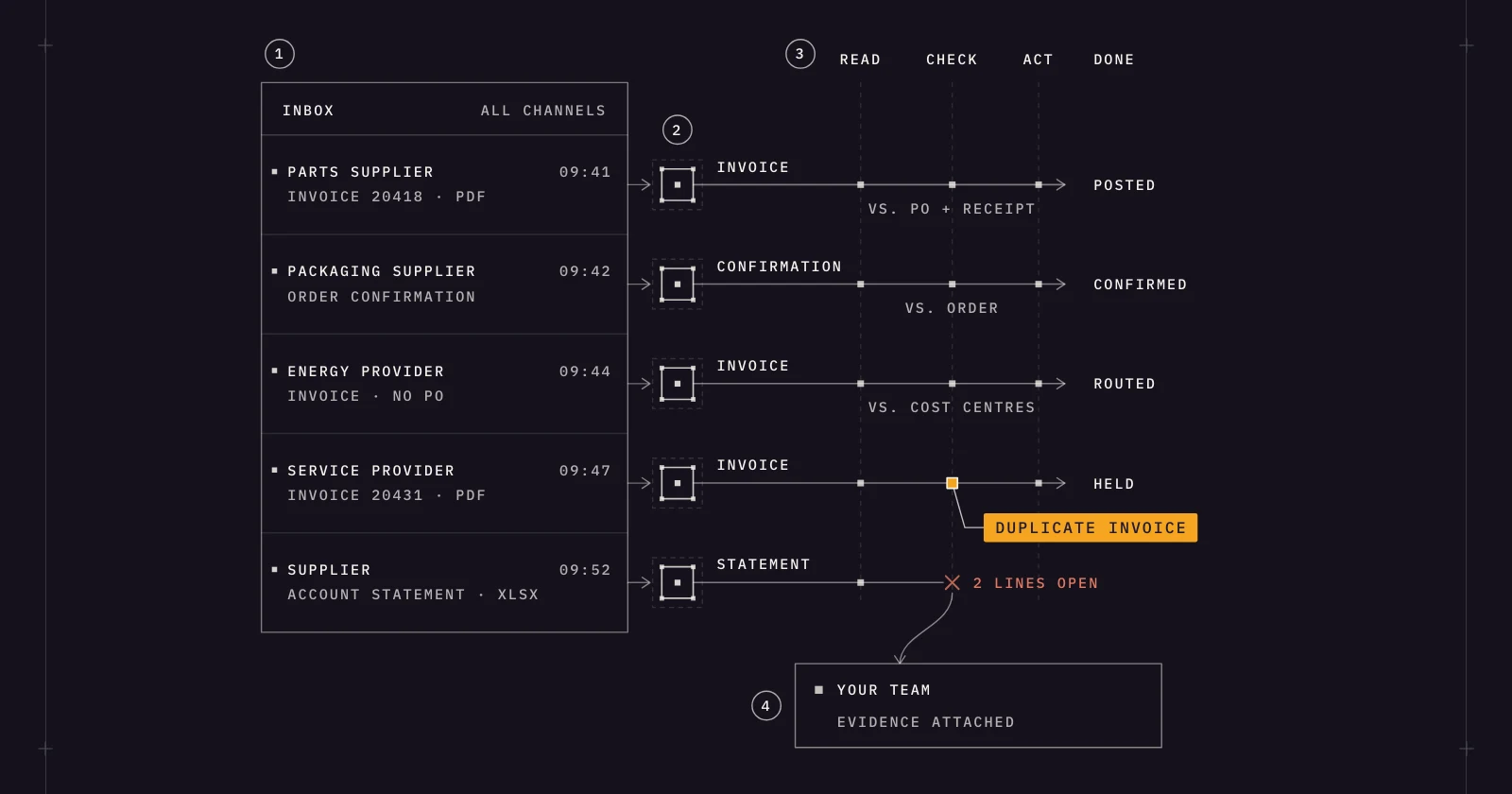
Most AP automation platforms start when an invoice is captured and stop when it is routed. cloudsquid starts in the mailbox where supplier invoices land and stops when the invoice is posted in the ERP, or handed to a person with the evidence.
cloudsquid is an autonomous inbox for finance and operations teams at companies that make, move and sell physical products. Every supplier invoice that arrives by email, as a PDF, by EDI or through a supplier portal becomes a task with its own AI agent. The agent reads the invoice and matches it at line level against the purchase order, the goods receipt, the agreed price and the supplier's order confirmation. It codes the invoice and routes it for approval under the company's own limits. Duplicates and price, tax and terms errors are caught before payment.
The work it takes over is what an AP clerk does when a PO invoice does not match: open the purchase order, look up the goods receipt, find the agreed price, ask the buyer, write to the supplier. Only exceptions reach the team, each with the evidence attached.
What makes cloudsquid different for AP automation in manufacturing and distribution:
Agents learn the process from the company's own SOPs, files, email and ERP history. Rules, approval limits, thresholds and escalation paths are set by the team, versioned and auditable. Approvals stay with people where the team wants them. When a person resolves an exception, the resolution becomes a rule, so the same exception does not come back.
cloudsquid works on top of the existing ERP (SAP, Oracle NetSuite, Microsoft Dynamics 365, Workday, Infor) and does not replace it. It is ISO 27001:2022 certified and offers EU data residency. There is no integration project to start: on day 1 the team forwards the mailbox and shares SOPs, sample cases and an ERP export, and in week 2 agents work the inbox. A regional foodservice distributor catches $250K per year in discrepancies before payment. At a US craft brewery, a $50K duplicate invoice surfaced.
cloudsquid is not a procure-to-pay suite, an e-invoicing network or a payment platform. It is the agent layer that does the checking, next to the ERP and whatever AP workflow is already in place. A company that needs a purchasing system or country e-invoicing mandates covered should look at the suites below.
Who cloudsquid is built for:
Manufacturers and distributors and wholesalers with PO-heavy direct spend, where supplier invoices arrive in a shared mailbox and someone still compares them by hand with purchase orders, goods receipts and price lists. It fits teams that already run an ERP, often with an AP workflow tool, and still resolve exceptions in Outlook.
2. Medius: Line-Level Matching for Goods-Based Spend
Medius is an AP automation vendor whose platform connects invoice capture, processing and supplier payment. It publishes dedicated pages for manufacturers and for Infor SyteLine and Infor CloudSuite Distribution. The company says matching happens at the line level instead of the document total, and states on its manufacturing page that 94.9% of invoices are processed automatically.
Key capabilities:
- Line-level matching: Invoice lines are matched against purchase orders, goods receipts and, where used, contracts.
- Partial receipts and backorders: Medius says these are handled without false exceptions; invoices waiting for a receipt are held and resolved when it arrives.
- Production orders: For Infor SyteLine, invoices are matched to POs, goods receipts and production orders at the line level.
- ERP connectors: Managed connectors; the manufacturing page names Dynamics 365, NetSuite, SAP, Oracle and Infor.
Medius's standout capability: Partial receipts without the exception queue
The classic failure of PO matching in distribution is the invoice that arrives before the full delivery. According to Medius, such invoices are queued and matched when the receipt is posted, and deviation rules can be set by supplier or department instead of globally.
Who Medius is built for:
Medius describes its product as built for manufacturing complexity (production orders, partial receipts, multi-site visibility) and for distributors with backorders and high SKU counts. It suits mid-size and large companies with high invoice volumes, often across more than one ERP.
3. Basware: PO Matching and E-Invoicing Compliance for Global Groups
Basware says its AP automation captures, checks, matches and routes every invoice for approval, then sends it to the ERP. PO invoices are matched against purchase orders, goods receipts and contracts before approval, at line level and header level. The company says its AI was trained on more than 2.5 billion invoices and that customers achieve up to 96% touchless invoice processing.
Key capabilities:
- Line and header matching: Uses any combination of invoice, POs, external POs, goods receipts, quality checks and contracts.
- SmartMatching: AI learns supplier and PO patterns to associate invoice lines with PO lines, including consolidated invoices across several POs and deliveries.
- AP Matching Agent: Explains why a match failed and recommends how to resolve it.
- E-invoicing compliance: Basware states that mandates in more than 60 countries are managed natively.
- ERP connectivity: Prebuilt connectors to SAP, Oracle, Microsoft Dynamics and more than 250 other systems.
Basware's standout capability: Matching when the PO data is incomplete
Basware notes that for global organizations up to 20% of PO-based invoices arrive with PO issues. Basware Guardian for AP flags invoices with missing or invalid PO data and predicts the likely PO. When information is missing, the matching engine calculates the best matching scenario from the data it has.
Who Basware is built for:
Basware names its fit: globally operating organizations that want to harmonize invoice processing across locations, more than 50,000 invoices per year, and finance shared service centers. A manufacturing group with plants in several countries matches that profile.
4. Esker: Accounts Payable Inside a Source-to-Pay and Order-to-Cash Platform
Esker was founded in Lyon, France, in 1985 and positions itself as an all-in-one platform for the office of the CFO, with source-to-pay and order-to-cash solutions. In accounts payable, Esker matches invoice data against purchase orders and goods receipts to identify issues early. Its product page cites 80%+ touchless invoices.
Key capabilities:
- Three-way matching: Matches purchase orders, receipts and invoices with full audit trails.
- AI capture and coding: Esker Synergy AI extracts invoice data, predicts coding and supports routing and exception management.
- Multi-ERP: AP across several ERP environments is managed from one cloud platform.
- Global compliance: Esker states compliance in 60+ countries and support for 135+ currencies.
Esker's standout capability: One vendor across payables and receivables
Manufacturers and distributors rarely have only an AP problem. Esker's source-to-pay suite covers procurement and accounts payable, and its order-to-cash suite covers the customer side, including accounts receivable and cash application. One platform across both cycles is the reason to shortlist Esker.
Who Esker is built for:
Esker describes its AP solution as built for large companies and complex finance organizations. It fits groups that run several ERPs, operate in many countries and want payables and receivables from one vendor.
5. OpenText Vendor Invoice Management for SAP Solutions: Invoice Processing Inside SAP
OpenText Vendor Invoice Management for SAP Solutions, usually shortened to VIM, runs as an add-on inside the SAP system. OpenText describes it as an SAP Solution Extension that supports all releases from ECC 6 up to the latest S/4HANA. VIM does not stop at the invoice: it is preconfigured for invoices, purchase orders, order confirmations, delivery notes, quotations and remittance advices.
Key capabilities:
- Capture from any source: Documents enter from business networks, EDI, email, upload or scan, with header and line-item extraction.
- Order confirmations and delivery notes: Purchase orders are updated with details from order confirmations, and goods receipts are posted based on delivery notes.
- Proposed actions: The system proposes preconfigured actions to solve an invoice problem, such as directly posting a goods receipt.
- Freight invoices: Integration with SAP Transportation Management supports complex freight invoices.
OpenText VIM's standout capability: Everything happens in SAP
OpenText says that incomplete or outdated information on the receiving side causes a significant share of invoice problems, and VIM corrects it at the source. Users work in SAP Fiori, every action is recorded in an audit trail, and the buyer, the goods receipt clerk and the AP clerk work on the same document in the same system.
Who OpenText VIM is built for:
Companies that run SAP ECC or SAP S/4HANA, on premises or in an SAP private cloud, and want invoices and the procurement documents around them processed inside that system.
6. xSuite: SAP-Certified Invoice Workflow With Order Confirmations and Delivery Notes
xSuite is a German software vendor, founded in 1994 and headquartered in Ahrensburg near Hamburg, that focuses on accounts payable in SAP. xSuite Invoice handles invoices with a purchase order reference (SAP MM) and without (SAP FI). The companion product xSuite Procurement reads incoming order confirmations and delivery notes.
Key capabilities:
- 3-way match and touchless posting: For PO invoices the system checks whether a 3-way match exists, which allows posting in the background.
- Order confirmations: Read automatically; discrepancies are highlighted and handled in a workflow.
- Delivery notes: Read and processed through to goods receipt posting.
- Item-level verification: Invoices can be released by individual item, with item-related account and cost center assignment.
- SAP certifications: xSuite states it is certified for SAP NetWeaver, SAP S/4HANA, SAP S/4HANA Cloud and SAP Clean Core.
xSuite's standout capability: The order confirmation is checked before the invoice arrives
xSuite makes the point that a buyer has to react quickly when the supplier's order confirmation diverges from the order in quantity, date or price. A change caught at that stage means the purchase order is correct when the invoice comes in.
Who xSuite is built for:
SAP customers, from ECC to S/4HANA Cloud, that want invoice processing embedded in SAP with a clean core option. xSuite says other ERP systems can be connected through its web client, but the product is optimized for SAP.
7. Tungsten Automation: Line-Item Capture and Matching, in and Outside SAP
Tungsten Automation is the former Kofax; the company took its new name in January 2024. Three products matter for AP. InvoiceAgility+ is its invoice-to-pay platform, with 2-way and 3-way PO matching and what Tungsten calls line-item AI pairing. AP Essentials is an invoice capture and validation solution with integrations for Oracle, NetSuite, Microsoft Dynamics 365 and Coupa. Process Director runs inside SAP.
Key capabilities:
- Line-item matching: 2-way matching of invoice to purchase order and 3-way matching that includes the goods delivered.
- Automatic posting: According to Tungsten, high-confidence matches post automatically and the rest route to human review.
- AI agents: InvoiceAgility+ lists agents for matching, coding, fraud assessment and translation.
- Process Director for SAP: Matches accounting information against SAP master and transactional data and catches discrepancies before transactions are finalized.
Tungsten Automation's standout capability: Line-item capture
A line-level match starts with reading the lines correctly. Tungsten states that its pre-trained invoice model reaches 95%+ first-time capture and that machine learning improves line-item extraction with each invoice processed. For long, multi-page material invoices, that decides whether line-level matching is possible at all.
Who Tungsten Automation is built for:
Companies that want one vendor for invoice capture and matching across different ERPs. SAP customers will look at Process Director; companies on Oracle, NetSuite, Dynamics 365 or Coupa at AP Essentials or InvoiceAgility+.
8. Yooz: Cloud AP Automation With AI Line-Level PO Matching
Yooz is a cloud platform for AP and purchase-to-pay automation, headquartered in Dallas, Texas, with offices in Europe. In April 2026 Yooz announced Line-Level Matching, an AI feature that extracts invoice lines and matches them against complex, multi-page PO lines. It names manufacturing, automotive and construction as target industries.
Key capabilities:
- 2-way and 3-way matching at line level: Invoices are paired with purchase orders and delivery receipts line by line.
- Complex scenarios: Covers multi-PO invoices, partial shipments, blanket POs and multiple receipts tied to a single invoice, with configurable tolerances.
- Exception handling: The AI recommends adjustments for price, quantity or item mismatches, and routing can depend on discrepancy type or threshold.
- Integrations: More than 250 ERP, accounting and document management systems, including SAP, Sage, Acumatica and Microsoft Dynamics.
Yooz's standout capability: One-click resolution of line exceptions
Yooz concentrates on what happens after a line fails to match. The clerk sees which lines do not match, gets a suggested adjustment and resolves the exception with notes, tasks and rules-based routing.
Who Yooz is built for:
Finance teams in procurement-heavy industries that want line-level PO matching in a cloud product without replacing their ERP.
9. Stampli: PO Matching With Partial Receipts on Top of the ERP
Stampli is an AP automation platform that centers collaboration, documentation and workflow on top of each invoice. The company says it deploys in weeks and supports more than 70 ERPs. For PO invoices, Stampli offers 2-way and 3-way matching and addresses receiving directly: it observes that for distribution, manufacturing and logistics companies, receiving is high in volume and rarely clean.
Key capabilities:
- Full and partial receipts: Invoices are processed against a PO with full or partial receipts.
- Tolerances: Approval is skipped automatically when PO and invoice match within customer-defined tolerances.
- Missing receipts: In NetSuite, invoices without a receipt are flagged and routed with full context, and the assigned receiver is notified.
- Multiple POs: Several POs can be applied to one invoice; blanket POs and freight charges are supported.
Stampli's standout capability: The conversation stays on the invoice
A mismatch on a PO invoice usually needs an answer from someone outside AP: the buyer who agreed the price, or the warehouse lead who signed for the delivery. Stampli makes the invoice itself the communication channel and the historical record.
Who Stampli is built for:
AP teams that want PO matching on top of the ERP they already run, among them Oracle NetSuite, Sage Intacct, Microsoft Dynamics 365, Acumatica and SAP, and that want a short rollout.
How to Choose the Right AP Automation Software for Manufacturing and Distribution
The tools on this list solve different parts of the problem. If your question is whether invoices that were already approved were approved correctly, see our comparison of invoice approval auditing software. Otherwise, answer these questions first.
1. How much of your invoice volume is PO-based direct spend?
If most invoices are non-PO, capture, coding and approval routing do the job, and almost every tool here will work. If most are PO invoices for materials and goods for resale, the match decides everything. Medius, Basware, Yooz, Stampli and cloudsquid all address line-level matching directly. Ask each vendor to show a partial delivery, a price change and a unit of measure difference on your own documents.
2. Which ERP do you run, and should the tool live inside it?
SAP customers can keep the process in SAP with OpenText Vendor Invoice Management, xSuite or Tungsten Process Director. Basware, Medius and Esker position themselves for groups with several ERPs, and Basware and Esker each state e-invoicing compliance in more than 60 countries. Teams on NetSuite, Sage, Acumatica or Microsoft Dynamics should look at Stampli and Yooz. cloudsquid works on top of the ERP and next to an AP tool that is already in place.
3. Where do your exceptions come from?
Pull a month of blocked invoices and sort them by cause. If the goods receipt is missing, look at how the tool waits: Medius holds the invoice until the receipt is posted, Stampli notifies the receiver, OpenText proposes posting the goods receipt directly. If prices changed after the PO was issued, the order confirmation is the missing document: xSuite and OpenText process it inside SAP, and cloudsquid matches the invoice against it. For consolidated invoices across several POs, look at Basware and Yooz.
4. How much project can you carry?
A suite replaces the AP process from capture to posting, and that is a project with IT. Ask every vendor for a timeline and a reference customer of your size. If the ERP and the AP workflow stay as they are and the problem is the manual checking in between, an agent layer is the shorter route: cloudsquid starts with a forwarded mailbox, SOPs, sample cases and an ERP export, and agents work the inbox in week 2.
What Good AP Automation Looks Like in Practice
Go back to the invoice for 480 cases. A tool that captures and routes reads it correctly, finds that quantity and price differ from the PO, and puts it in an exception queue. The clerk then does what the clerk always did.
A tool that checks at line level sees that 460 cases were received, processes what was received and holds the remainder until the receipt is posted. It finds the order confirmation with the new price and checks whether the increase was accepted. If not, the line goes to the buyer with both documents attached.
Tolerances matter as much as matching. A rounding difference of two cents on a unit price should not stop a $40,000 invoice. Good tools let the team set tolerances by supplier or amount and keep each rule auditable.
Waiting is not an exception. An invoice that arrives before the goods should wait and clear by itself when the receipt is posted. Mixing those invoices with true discrepancies is what makes exception queues unmanageable.
Measure the result on PO invoices alone. An overall touchless rate hides the difference between a utility bill and a 60-line material invoice. Track how many PO invoices post without a touch and how many exceptions repeat for the same supplier and reason.
An exception that is resolved once and written down as a rule does not come back. To see how that works on your own supplier invoices, book a demo.
Frequently Asked Questions
What is AP automation for manufacturing? It is software that receives supplier invoices, reads them, matches them against purchase orders and goods receipts, routes exceptions and approvals, and posts the result to the ERP. Compared with general AP automation, the weight is on PO-based direct spend: line-level matching, partial deliveries, price variances and freight charges.
What is 3-way matching? 3-way matching compares the supplier invoice with the purchase order and the goods receipt, so that only what was ordered and received is paid. 2-way matching compares the invoice with the purchase order alone. Services usually have no receipt and are matched 2-way or approved by the cost owner.
What is the difference between header-level and line-level matching? Header-level matching compares the invoice total with the PO total. Line-level matching compares each invoice line with its PO line and receipt: item, quantity, unit price and unit of measure. An invoice can agree in total and still be wrong on single lines.
How does AP automation handle partial deliveries? It matches the invoice against the quantity received so far. Tools differ in what happens next: some hold the invoice until the remaining receipt is posted, some notify the receiver, some send it to an exception queue.
Which AP automation software works with SAP? OpenText Vendor Invoice Management, xSuite and Tungsten Process Director run inside SAP ECC and SAP S/4HANA. Basware, Medius, Esker, Yooz and Stampli connect to SAP from their own platforms. cloudsquid also connects to SAP and works on top of it.
How long does it take to implement AP automation? It depends on how deep the tool goes into the ERP. Cloud tools on top of the ERP can go live in weeks, as Stampli states for its product. SAP-embedded products and global suites usually involve IT, so ask each vendor for a timeline. cloudsquid needs no integration project to start and is live in two weeks.
What is the ROI of AP automation for manufacturers and distributors? The return comes from less time per PO invoice, fewer overpayments from price variances, duplicates and quantities that were never received, more early payment discounts taken, and fewer blocked invoices. Overpayments are the hardest to see, because one that nobody caught does not show up in any report.
Related Comparisons
Über den Autor
Co-founder & CPO, Cloudsquid
Filip Rejmus, co-founder and Chief Product Officer at cloudsquid, is building infrastructure to help companies manage, scale, and optimize AI workflows. With a background spanning software engineering, data automation, and product strategy, he bridges the gap between AI research and building useful, friendly Products.Before founding Cloudsquid, Filip worked in engineering and data roles at Taktile, SoundHound, and Uber, and contributed to open-source projects through Google Summer of Code. He studied Computer Science at TU Berlin with additional coursework in Quantitative Finance at TU Delft and Computer Graphics at UC Santa Barbara.
Weiterlesen
Weitere Beiträge für Ihr Team.
Finance Operations 17 Min. Lesezeit
9 Best Sales Order Automation Software Tools for 2026
Artikel lesen
Finance Operations 17 Min. Lesezeit
9 Best AI Agents for Finance Operations in 2026
Artikel lesen
Finance Operations 17 Min. Lesezeit
9 Best B2B Customer Service Automation Tools for Manufacturers and Distributors in 2026
Artikel lesenNächster Schritt
Automatisieren Sie den Workflow hinter diesem Artikel.
Bringen Sie Ihre Dateien und Regeln mit. Cloudsquid setzt daraus in wenigen Wochen einen prüfbaren KI-Workflow um.