
Blog
Vendor Master Deduplication: Finding and Consolidating Duplicate Vendor Records
February 13, 2026


.svg)

The vendor master that grows but never gets cleaned
Every company with more than a few hundred vendors has duplicate records in the vendor master. Not because anyone made an obvious mistake, but because over time the same vendor enters the system under slightly different names, with slightly different addresses, and sometimes with different tax IDs or bank details depending on which subsidiary or division submitted the paperwork.
Vendor master deduplication is one of those tasks that everyone agrees is important and almost no one gets to. The AP team knows the duplicates exist. They encounter them during invoice processing when a payment run pulls up two records for what is clearly the same vendor. The controller knows it matters because it shows up in audit findings and distorts spend reporting. But the cleanup never reaches the top of the priority list because it is labor-intensive, requires judgment on every match, and the consequences of getting it wrong (merging two vendors that are actually distinct entities) are worse than leaving the duplicates in place.
The result is a vendor master that grows indefinitely. Records accumulate. Spend data fragments across duplicates. Payment terms become inconsistent for the same vendor. And the annual 1099 process turns into a reconciliation exercise because the same payee appears under multiple taxpayer IDs.
How duplicate vendor records accumulate
Duplicate vendors are not a one-time data quality problem. They are a recurring byproduct of how vendor records get created in the normal course of business.
Multiple entry points, no central gating
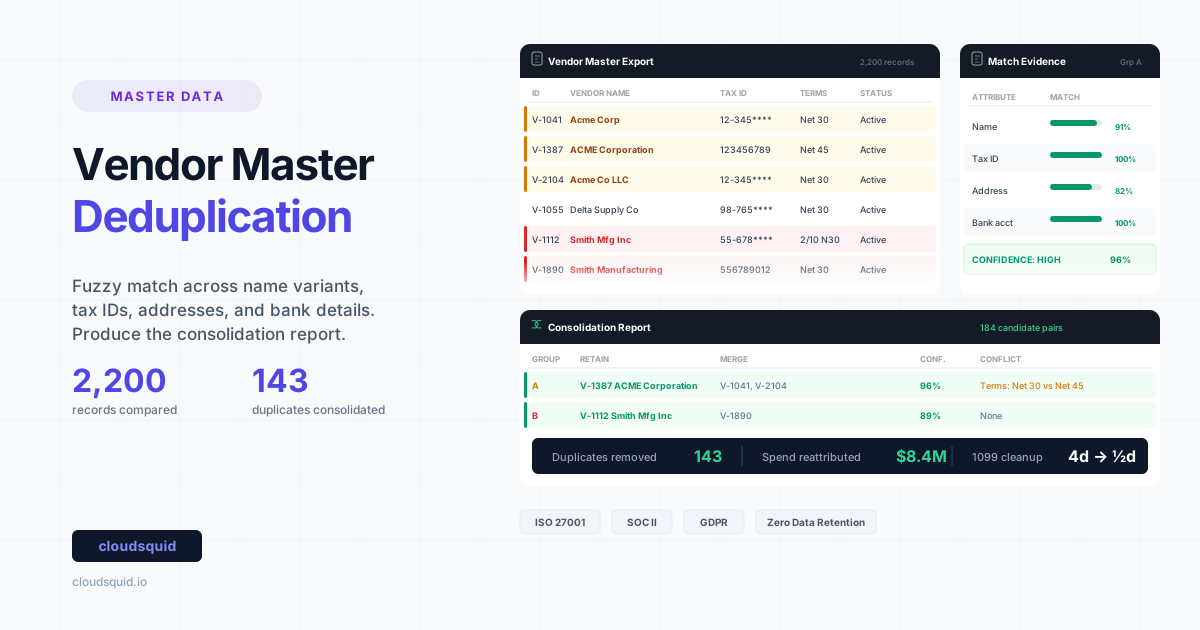
In most organizations, vendor records are created by AP when a new invoice arrives, by procurement when a PO is issued, or by a department that submits a vendor setup form. Each entry point applies different naming conventions. AP enters "Acme Corp" from the invoice header. Procurement enters "ACME Corporation" from the contract. The department enters "Acme Co LLC" from the W-9. Three records, one vendor.
ERP systems with duplicate-check logic at the point of entry help, but the checks are typically exact match on name or tax ID. "Acme Corp" and "ACME Corporation" pass the duplicate check because they are not string-identical. A tax ID entered with a dash (12-3456789) and without (123456789) may also pass, depending on the system.
Acquisitions and system migrations
When companies merge, vendor masters merge. The acquired company's vendors are loaded into the parent's ERP, often in bulk, with minimal deduplication because the priority is keeping payments flowing. Vendors that existed in both systems before the acquisition now exist twice in the combined system.
ERP migrations produce the same result. Data is extracted from the legacy system, cleaned to the extent time allows, and loaded into the new system. Cleanup focuses on obviously invalid records (missing names, inactive vendors with no recent transactions). Duplicates that differ by name spelling, address formatting, or tax ID formatting survive the migration.
Vendor-initiated changes
Vendors change legal names, merge with other companies, or restructure their entities. A vendor that was "Smith Manufacturing Inc" becomes "Smith Industries LLC" after a reorganization. If the vendor submits a new W-9 with the updated name and entity type, the AP team may create a new record rather than update the existing one, particularly if the tax ID also changed. The old record remains active with historical transactions, and the new record begins accumulating new ones.
The remit-to problem
Large vendors often have multiple remit-to addresses, bank accounts, or divisions that invoice separately. A facilities management vendor might invoice from their cleaning division, their security division, and their maintenance division, each with a different remit-to address but the same parent tax ID. Whether these should be one vendor record or three is a business decision, but in practice they often end up as three records created independently, with no link between them.
What duplicate vendors cost the organization
The cost of duplicate vendor records is distributed across several functions, which is part of why it does not trigger urgent cleanup. No single team bears the full impact.
Fragmented spend visibility
Spend analysis depends on accurate vendor-level aggregation. When the same vendor exists under three records, the spend is split three ways. A vendor that represents $1.2 million in annual spend appears as three vendors at $400,000 each. The procurement team's top-vendor report is wrong. Volume discount thresholds are understated. Contract renegotiation opportunities are missed because the data does not reflect the true relationship size.
Duplicate payment risk
Two records for the same vendor means two invoices for the same service can be paid separately without triggering the ERP's duplicate invoice detection. Duplicate detection logic typically checks within a single vendor ID: same vendor, same invoice number, same amount. When the duplicates are spread across two vendor IDs, the check does not fire.
Industry benchmarks place duplicate payment rates at 0.1-0.5% of total disbursements. For a company with $50 million in annual payables, that is $50,000 to $250,000. A meaningful portion of these duplicates are enabled by duplicate vendor records.
Inconsistent payment terms
When the same vendor has multiple records, each record may carry different payment terms. One says Net 30, another says Net 45, a third has a 2% early payment discount. The terms applied to a given invoice depend on which vendor record the AP clerk selects. The vendor's actual negotiated terms may not be applied consistently.
1099 reporting errors
At year-end, payments to the same vendor under different tax IDs produce separate 1099s. Payments under the same tax ID but different vendor records may or may not consolidate correctly, depending on how the ERP aggregates. Underreported or duplicate 1099s create IRS compliance exposure and require manual correction after the initial filing.
Audit findings
External auditors flag duplicate vendor records as a control weakness. The finding is not about the duplicates themselves but about what they indicate: that the vendor master lacks adequate controls over record creation, that spend data may be unreliable, and that the organization is exposed to duplicate payment risk. The remediation effort after an audit finding is the same deduplication work that was deferred, now with a deadline.
What systematic vendor master deduplication requires
Manual deduplication typically involves pulling the vendor master into a spreadsheet and sorting by name, looking for obvious duplicates. This catches "Acme Corp" next to "Acme Corporation" but misses "Acme Corp" and "ACM Corp" separated by 200 rows. It also misses duplicates with entirely different names but the same tax ID or bank account.
A systematic review evaluates multiple attributes simultaneously and scores the probability that two records represent the same vendor.
1. Name variant matching
Beyond exact string comparison, deduplication needs to handle abbreviations (Corp/Corporation/Inc/LLC), punctuation differences (Acme, Inc. vs Acme Inc), word order (Smith & Jones vs Jones and Smith), and common misspellings. "Intl" and "International" are the same word. "Mfg" and "Manufacturing" are the same word. Whitespace and capitalization differences are noise.
Name matching alone produces candidates, not confirmations. Two vendors can have similar names and be distinct entities. The name match is the first filter, not the final determination.
2. Tax ID comparison
Matching on EIN or SSN is the strongest single indicator that two records are the same vendor. But tax IDs in vendor masters are often incomplete (last four digits only for security), formatted inconsistently (with and without dashes), or missing entirely for international vendors or vendors onboarded before tax ID collection was enforced.
Tax ID matches confirm a duplicate. Tax ID mismatches do not rule one out, because the same vendor may have submitted different tax IDs for different entities within their corporate structure.
3. Address normalization and comparison
Street addresses in vendor records reflect whatever the vendor wrote on their W-9 or whatever the AP clerk typed. "123 Main Street, Suite 400" and "123 Main St Ste 400" and "123 Main St., #400" are the same address. Comparing them requires normalizing street suffixes, unit designators, and abbreviations before matching.
Address matching is particularly useful for confirming name-variant matches and for identifying vendors that share a physical location (which may indicate a parent-subsidiary relationship or a shared office address that is coincidental).
4. Bank account and payment detail matching
Two vendor records with the same bank routing number and account number are very likely the same vendor, regardless of what the name field says. Payment detail matching catches duplicates that have completely different names but the same financial identity, such as a vendor that changed its legal name but kept the same bank account.
5. Transaction pattern analysis
Two vendor records in the same spend category, with similar invoice amounts, similar invoice frequencies, and overlapping active periods may represent the same vendor even if the name, tax ID, and address do not match cleanly. This is the weakest signal individually but adds confidence when combined with partial matches on other attributes.
From reviewing the full vendor master to reviewing the match candidates
The time-intensive portion of vendor master deduplication is the comparison: evaluating every possible pair of vendor records across five attributes, scoring the match probability, and surfacing the candidates that warrant review. In a vendor master with 2,000 records, that is nearly 2 million possible pairs. Manual review is not a realistic approach at that scale.
The Agent handles the comparison. Upload the vendor master export (all fields: name, tax ID, address, bank details, payment terms, status) and optionally the payment history for transaction pattern analysis. Describe what the deduplication should evaluate:
"Identify probable duplicate vendor records. Match on name variants, tax ID, normalized address, and bank account details. Score each candidate pair by match strength. For confirmed duplicates, recommend which record to retain based on transaction recency and data completeness. Produce a consolidation report with the proposed master record, the records to merge, and the specific evidence for each match."
The output is a consolidation report: every candidate pair, ranked by match confidence, with the specific attributes that matched (name similarity score, tax ID match, address overlap, shared bank details) and the evidence cited. For high-confidence matches, the report recommends which record to retain (typically the one with more complete data and more recent transactions) and flags any conflicting data that needs resolution before merging (different payment terms, different tax IDs that may represent distinct legal entities).
The team reviews the match candidates, confirms or rejects each proposed consolidation, and resolves the conflicts. The comparison work that would take weeks for a large vendor master is handled. The team focuses on the judgment calls: is this truly a duplicate, which record should survive, and do the conflicting payment terms need to be reconciled with the vendor.
The Agent works with the files the team already has: an ERP vendor master export, optionally a payment history extract. No system integration required.
What the numbers look like
A mid-market CPG company with 2,200 vendor records accumulated over eight years, including one acquisition.
Before: The AP manager knows duplicates exist because the team encounters them during invoice processing, roughly two to three per week. A cleanup project was planned for Q3 but deferred when two team members left. The last comprehensive deduplication was done during the ERP migration five years ago. The annual 1099 process requires four days of manual reconciliation to catch split payments across vendor records. The most recent external audit flagged vendor master controls as a finding for the second consecutive year.
After: All 2,200 records compared across name, tax ID, address, and bank details. The consolidation report identifies 184 candidate pairs. Of those, 127 are high-confidence matches (name variant plus at least one confirming attribute). Thirty-one are medium-confidence (strong name match, no confirming attribute). Twenty-six are low-confidence (flagged for review based on shared address or bank details with dissimilar names). The AP manager reviews and confirms 143 consolidations in a day and a half, resolves 12 payment term conflicts, and flags 6 cases for follow-up with the vendor. Net reduction: 143 duplicate records removed, representing $8.4 million in previously fragmented spend now correctly attributed. The 1099 process drops from four days to half a day.
The specifics shift by industry:
- In CPG, broker and distributor networks generate vendor duplication because the same broker operates under different entity names in different regions. A broker covering the Southeast and the same broker covering the Mid-Atlantic may appear as two vendors with different addresses and different DBAs but the same parent entity and the same tax ID. Consolidating broker records is the prerequisite for accurate commission reconciliation.
- In manufacturing, raw material suppliers often have multiple divisions that invoice independently (chemicals division, plastics division, packaging division). Whether these should consolidate depends on whether the company manages the relationship at the parent level or the division level. The deduplication review surfaces these structural questions that the vendor master has been silently obscuring.
- In retail, vendor masters grow rapidly through seasonal and promotional vendors. A holiday pop-up supplier, a promotional merchandise vendor, and a specialty packaging company may each appear as new vendor records every season because the prior year's record was deactivated and a new one created. The same vendor accumulates three or four records over as many years, each with a partial transaction history.
Every match, score, and recommendation is documented with the specific evidence. When the auditors ask how vendor master controls were strengthened, the consolidation report is the deliverable.
The longer the cleanup is deferred, the more it costs
Vendor master deduplication is a compounding problem. Every month without cleanup is another month of fragmented spend data, another month of duplicate payment exposure, and another set of vendor records that will need to be reviewed when the cleanup eventually happens.
The constraint has been the comparison work: evaluating thousands of records across multiple attributes, normalizing inconsistent data, and surfacing the candidates that actually warrant human review. When that comparison runs systematically against every record, the cleanup becomes a review exercise instead of a research project. The vendor master that has been growing for years gets cleaned in days.