
Blog
Intercompany Reconciliation: Eliminating the Bottleneck Before Consolidation
February 13, 2026


.svg)

The reconciliation that blocks the close
Multi-entity companies close the books twice. First at the entity level, then at the consolidated level. Between those two closes sits intercompany reconciliation: the process of confirming that what Entity A recorded as a receivable from Entity B matches what Entity B recorded as a payable to Entity A.
In theory, the balances should match. Entity A invoices Entity B for $240,000 in shared services. Entity A books a receivable. Entity B books a payable. Both sides agree. The intercompany entries eliminate cleanly in consolidation.
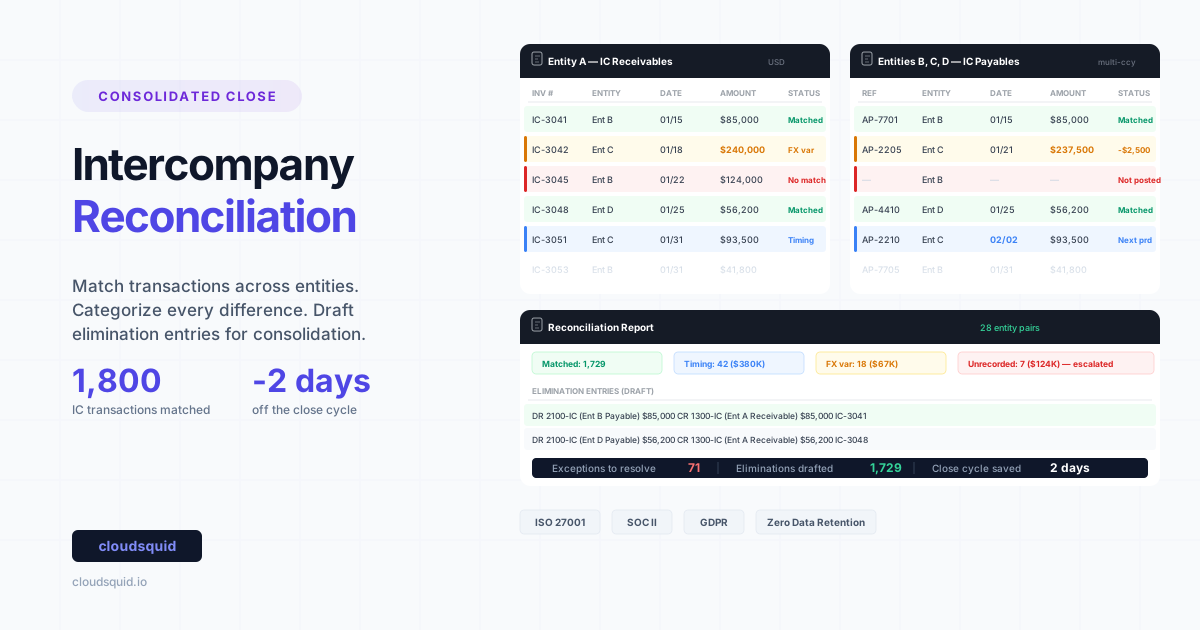
In practice, they rarely match. Entity A booked $240,000. Entity B booked $237,500. The difference might be a timing issue (Entity B received the invoice on the last day of the month and posted it to the next period), a currency translation variance, a partial payment already applied, or an invoice Entity B disputes and has not recorded. Multiply that by every intercompany relationship in the organization, across every transaction type, across every currency, and the reconciliation becomes one of the most time-consuming steps in the consolidated close.
Intercompany reconciliation sits on the critical path. The consolidated financial statements cannot be issued until intercompany balances are reconciled and eliminated. Every hour spent investigating intercompany differences is an hour added to the close cycle. For companies with 10, 20, or 50 entities, the reconciliation work is substantial, and it recurs every month.
Why intercompany balances don't match
Intercompany transactions should be mirror images. They are not, for reasons that are systematic rather than incidental.
Timing differences across entity close schedules
Entity A closes on the 3rd business day. Entity B closes on the 5th. A transaction posted by Entity A on the 2nd may not appear in Entity B's books until the 4th. Both entities recorded the transaction in the correct period by their own calendars, but the intercompany balances do not match as of Entity A's close date.
Timing differences are the most common source of intercompany variance. They are also the most tedious to resolve because the investigation requires comparing transaction dates across both entities' ledgers to confirm that the mismatch is purely timing and will clear in the next period.
Currency translation at different rates
Entity A invoices Entity B in euros. Entity A converts to USD using the rate on the invoice date. Entity B converts using the rate on the posting date, three days later. The FX rate moved. Both entries are correct by each entity's accounting policy, but the USD amounts differ by $2,300.
Currency variances compound across high-volume intercompany relationships. A parent company with 15 international subsidiaries generating hundreds of intercompany transactions per month in multiple currencies will have translation differences on a significant percentage of transactions.
Disputed or unrecorded invoices
Entity A invoices Entity B for management fees. Entity B's controller questions the allocation methodology and does not post the invoice pending resolution. Entity A has a receivable. Entity B has nothing. The intercompany balance is off by the full invoice amount, and it will remain off until the dispute is resolved or the invoice is posted.
Disputed transactions are particularly problematic because they require communication between entity controllers, not just data comparison. The reconciliation surfaces the dispute, but resolving it is a business decision, not an accounting correction.
Different GL account or cost center coding
Entity A records the intercompany sale in account 4100-IC. Entity B records the corresponding purchase in account 5200-IC. Both amounts match, but the intercompany elimination mapping expects the same account code on both sides. The entries eliminate on amount, but the account-level reconciliation shows a mismatch.
Coding inconsistencies are common when entities use different charts of accounts, different ERP instances, or different naming conventions for intercompany accounts. The balances may be correct in total but the detail does not reconcile at the account level.
Partial payments and unapplied cash
Entity B makes a partial payment against Entity A's invoice. Entity A applies the payment to the receivable. Entity B records the payment but does not specify which invoice it covers. Entity A's receivable is reduced. Entity B's payable is reduced by the same amount, but the remaining open items do not match because the payment was applied differently on each side.
Unapplied cash is a persistent problem in intercompany reconciliation. The total owed may be agreed upon, but the allocation across individual invoices differs, making invoice-level reconciliation impossible until the cash is applied on both sides.
What intercompany reconciliation needs to match
A systematic intercompany reconciliation compares transactions and balances across entity pairs, identifies the differences, and categorizes each difference by type so the accounting team can resolve them efficiently.
1. Balance-level comparison by entity pair
The starting point: does Entity A's receivable from Entity B equal Entity B's payable to Entity A? This comparison runs across every entity pair in the organization. A company with 10 entities has up to 45 bilateral relationships to reconcile. A company with 25 entities has up to 300.
The balance comparison identifies which entity pairs have differences and the magnitude of each. This sets the priority for transaction-level investigation.
2. Transaction-level matching
Each intercompany transaction recorded by Entity A should have a corresponding entry on Entity B's books. Matching requires comparing invoice numbers, amounts, dates, and descriptions across two separate ledger extracts that may use different formats, different currencies, and different reference conventions.
Matched transactions confirm. Unmatched transactions on Entity A's books (recorded by A but not by B) indicate timing differences or unrecorded invoices. Unmatched transactions on Entity B's books (recorded by B but not by A) indicate the reverse. The unmatched population is where the reconciliation work concentrates.
3. Currency variance isolation
For transactions in foreign currencies, the reconciliation needs to separate amount differences caused by FX translation from amount differences caused by genuine discrepancies. A $2,300 variance on a EUR 200,000 transaction is likely FX. A $23,000 variance on the same transaction is not.
Isolating currency variances requires the original transaction currency, the exchange rates used by each entity, and the policy for when FX gains/losses are recognized. Once isolated, currency variances can be handled through a standard FX adjustment rather than treated as reconciling items.
4. Aging of open items
Intercompany items that have been open for 30 days may be timing. Items open for 90 days are likely disputes or errors. Items open for 180 days are problems. Aging the unreconciled items by entity pair gives the accounting team a view of where chronic issues persist, which entity pairs generate the most reconciling items, and where process changes are needed.
5. Elimination entry preparation
The end product of intercompany reconciliation is a set of elimination entries for consolidation. Matched intercompany receivables and payables eliminate against each other. Intercompany revenue and cost of sales eliminate. Intercompany profit in inventory eliminates. Each elimination entry must reference the matched transactions and the entity pair.
From investigating every difference to reviewing the exceptions
The time-intensive portion of intercompany reconciliation is the matching: pulling ledger extracts from each entity, standardizing the formats, comparing transactions line by line, identifying what matches and what does not, and then investigating each unmatched item to determine whether it is timing, currency, a dispute, or an error.
The Agent handles the matching and categorization. Upload the intercompany ledger extracts from each entity (GL detail filtered to intercompany accounts) and the intercompany invoice register if one exists. Describe what the reconciliation should produce:
"Match intercompany transactions across all entity pairs. Identify matched transactions, timing differences, currency variances, unrecorded items, and coding mismatches. Categorize each unmatched item by type. Produce a reconciliation summary per entity pair showing the balance difference, the composition of that difference by category, and draft elimination entries for the matched transactions."
The output is a reconciliation package: each entity pair, the balance-level comparison, the matched and unmatched transactions, and each unmatched item categorized as timing (posted by one entity, not yet by the other), currency variance (same transaction, different translated amounts), unrecorded (no corresponding entry found), or coding mismatch (amounts match, accounts do not). For matched transactions, elimination journal entries are drafted.
The accounting team reviews the exceptions by category. Timing items are confirmed and noted for next-period clearance. Currency variances are booked through the standard FX adjustment process. Unrecorded items are escalated to the relevant entity controller. Coding mismatches are corrected. The investigation work that consumed days is replaced by a categorized exception review.
The Agent works with the files the team already has: GL detail exports from each entity's ERP, filtered to intercompany accounts. No consolidation system integration required.
What the numbers look like
A mid-market manufacturing group with 12 entities across four countries and roughly 1,800 intercompany transactions per month.
Before: The consolidation team spends three to four days after entity-level close reconciling intercompany balances. The process involves pulling GL extracts from three different ERP instances, reformatting each into a common template, and manually matching transactions across 28 active entity pairs. The team typically resolves 85-90% of differences within the close window. The remaining 10-15% are booked as reconciling items and carried forward, creating a rolling backlog of unresolved intercompany differences that grows by $150,000-200,000 per quarter. The most recent external audit cited intercompany reconciliation as an area requiring improvement.
After: All 1,800 transactions matched across 28 entity pairs. The reconciliation report categorizes the differences: 42 timing items ($380,000 total, will clear next period), 18 currency variances ($67,000, booked as FX adjustments), 7 unrecorded invoices ($124,000, escalated to entity controllers), 4 coding mismatches (corrected same day). Elimination entries drafted for all matched transactions. The consolidation team reviews and finalizes the reconciliation in six hours. Close cycle shortened by two days. Quarterly backlog of unresolved items reduced from $150,000-200,000 to under $20,000.
The specifics shift by industry:
- In manufacturing, intercompany transactions often include transfer pricing for goods moving between a production entity and a distribution entity. The production entity records revenue at transfer price. The distribution entity records inventory at the same price. But if the entities use different costing methods or the transfer price was updated mid-period, the amounts diverge. Reconciling transfer pricing transactions requires matching not just the invoice but the underlying cost basis.
- In CPG, intercompany management fees and shared service allocations are common sources of disputes. A central entity allocates IT costs across 8 operating entities based on headcount. Each operating entity may disagree with the allocation percentage, the base cost, or the timing. These disputed allocations sit as unreconciled items month after month until someone forces resolution.
- In retail, intercompany inventory transfers between stores, warehouses, and e-commerce fulfillment centers generate high-volume, low-dollar intercompany transactions. A pallet of product moving from warehouse to store is an intercompany sale and purchase. Thousands of these transactions per month, each individually small, create a matching exercise where the volume is the challenge, not the complexity.
Every match, variance, and exception is documented with the source transactions from both entities. When the auditors review the intercompany reconciliation, the categorization and evidence are already assembled.
The close can only move as fast as the slowest reconciliation
Intercompany reconciliation is rarely the most complex step in the consolidated close. But it is often the longest, because the volume of transactions, the number of entity pairs, and the variety of difference types make it resistant to shortcuts. Teams that close entity books in three days may spend another three days on intercompany reconciliation before consolidation can begin.
The constraint is the matching and categorization work: comparing thousands of transactions across entities, identifying what corresponds, and determining why the unmatched items do not agree. When that comparison runs systematically, the team moves directly to exception resolution. The close accelerates by the number of days that were previously spent on the matching itself.