
Blog
GL Coding Errors After Month-End: Catching Miscoded Transactions Systematically
February 13, 2026


.svg)

The post-close cleanup that never goes away
Every month-end close produces a trial balance. And every trial balance produces the same question from the Controller: does anything look wrong?
GL coding errors are among the most persistent problems in the close cycle. Transactions coded to the wrong general ledger account, the wrong department, or the wrong cost center. They distort account balances, create variances in management reporting, and generate reclassification entries that consume accounting team hours in the days after close.
The review process at most companies is a manual scan of the trial balance. Someone with enough institutional knowledge looks at account balances, compares them to prior periods, and flags anything that seems off. A $47,000 balance in an account that normally runs under $10,000. Activity in a GL account that should be dormant. A vendor that typically hits office supplies showing up in professional services.
This works, to a point. It catches the large, obvious anomalies. What it misses are the coding errors that produce plausible balances. A $3,200 invoice coded to the wrong expense account does not move the trial balance enough to trigger a review when the account already carries $180,000 in activity. The error is invisible at the account level and only detectable at the transaction level.
The result is a persistent population of miscoded transactions that flow through to financial statements, distort departmental cost reporting, and accumulate until an auditor or a budget owner catches them months later.
Why GL coding errors are structural, not incidental
GL coding errors are not caused by carelessness. They are a predictable outcome of how transactions enter the general ledger.
The coding decision happens at the wrong point in the process
Most GL coding happens during invoice entry or payment processing. An AP clerk selects the GL account based on the vendor name, the invoice description, or a default coding rule in the ERP. The clerk may process invoices for hundreds of vendors across dozens of expense categories. The coding decision is made quickly, in the context of processing volume, not in the context of accounting accuracy.
The person who would catch a coding error, the accountant responsible for that GL account, does not see the transaction until after the books are closed. By that point, the entry has been posted, the period may be locked, and the correction requires a reclassification journal entry in the current period.
Default account assignments drift
ERPs assign default GL accounts to vendors at setup. Over time, the nature of what a company buys from a vendor changes. A facilities maintenance vendor starts providing consulting services. An office supply vendor begins selling IT equipment. The default GL account remains unchanged, and every invoice from that vendor is coded to the original account unless someone overrides it manually.
This drift is invisible in the normal course of processing. The default coding is technically valid, the system accepted it, and the invoice was paid. The error only becomes apparent when someone reviews what is actually in each account.
Chart of accounts ambiguity
Many charts of accounts contain accounts with overlapping descriptions. Software licenses vs. software subscriptions vs. SaaS fees vs. IT services. Professional services vs. consulting vs. advisory fees vs. management fees. Office supplies vs. office equipment vs. computer supplies.
When the coding decision is ambiguous, different clerks make different choices. The same type of expense ends up in different accounts depending on who processed the invoice. This creates inconsistency that does not show up as an obvious error on any individual transaction but distorts account balances in aggregate.
Journal entries bypass the controls
Manual journal entries, intercompany allocations, and accrual reversals bypass the AP coding workflow entirely. These entries are created by accountants, often under time pressure at close, with the GL account selected from memory or copied from a prior entry. An allocation that should hit cost center 4200 is posted to 4020 because the digits are transposed. A reversing entry that should credit 5100 credits 5010.
Journal entry errors are particularly consequential because they tend to involve larger amounts and often affect balance sheet accounts where the error persists until someone reconciles.
What a systematic GL coding review needs to evaluate
A trial balance review catches anomalies at the account level. A systematic GL coding review operates at the transaction level, evaluating each entry against the patterns that define correct coding for that type of transaction.
1. Vendor-account consistency
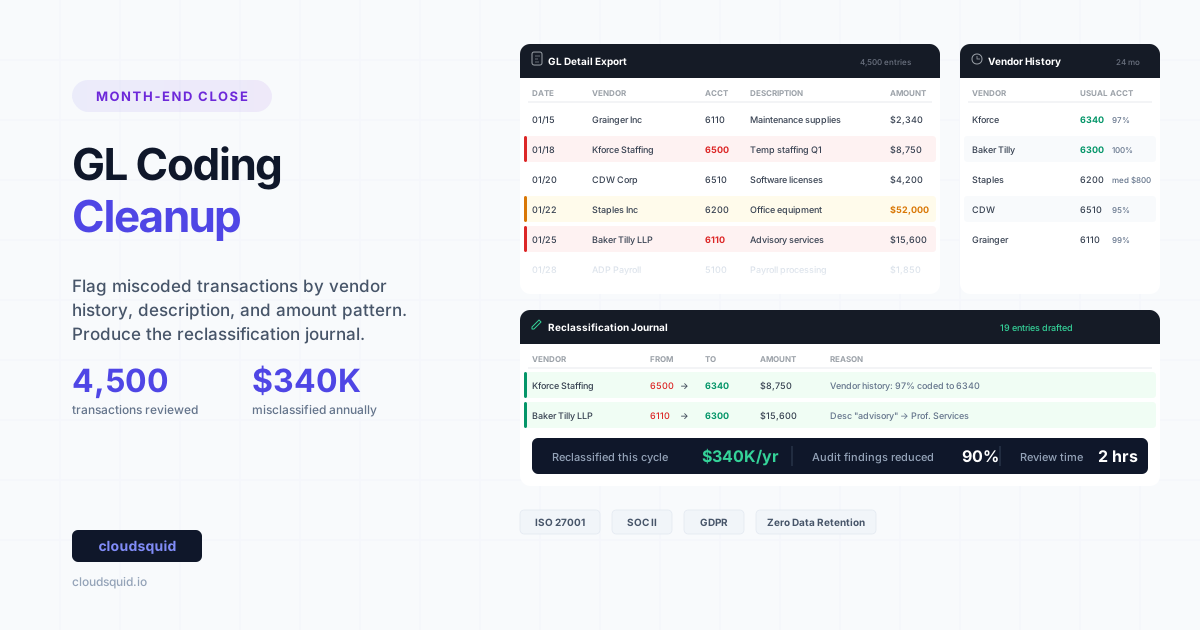
Every vendor has a historical coding pattern. If 95% of invoices from a given vendor have been coded to account 6110 over the past 24 months and the current month has an entry in 6340, that entry warrants review. The exception may be legitimate, a new type of purchase from that vendor, or it may be a coding error.
Vendor-account consistency checking is the highest-yield review. It catches the most common type of GL coding error: an invoice coded to the wrong expense account because the AP clerk selected the wrong default or overrode the default incorrectly.
2. Description-based classification
Invoice descriptions contain information that maps to GL accounts. "Annual software license renewal" should not appear in an account designated for office supplies. "Temporary staffing services" should not appear in a travel expense account. "Equipment repair" should not appear in a capital expenditure account.
Description-based review catches errors that vendor-account consistency misses, particularly when a vendor provides multiple types of goods or services. The vendor may be correctly associated with multiple GL accounts, but the specific invoice description indicates which account is appropriate for that transaction.
3. Amount pattern analysis
Each GL account has a characteristic transaction profile. Some accounts carry many small transactions (office supplies, travel meals). Others carry fewer, larger transactions (consulting engagements, equipment purchases). An unusually large entry in a typically small-transaction account, or an unusually small entry in a large-transaction account, may indicate miscoding.
A $52,000 entry in an account where the median transaction is $800 does not necessarily mean the entry is wrong. But it means the entry should be verified.
4. Department and cost center validation
A transaction may be coded to the correct GL account but the wrong department or cost center. The expense is real, the account is appropriate, but the cost allocation is wrong. This has no impact on the consolidated financial statements but distorts management reporting, departmental budgets, and cost center profitability analysis.
Department coding errors are often systematic. An allocation template assigns costs to the wrong department. A new cost center is created but the ERP defaults are not updated. All invoices for a service used by department 300 continue to code to department 200 because the vendor setup was never changed.
5. Accrual reversal and journal entry accuracy
Accrual entries at month-end and their reversals in the following period should net to zero. An accrual posted to account 5100 that reverses into account 5010 creates an unexplained variance in both accounts. Manual journal entries that allocate costs across accounts should sum to zero across the debit and credit accounts; any imbalance indicates a posting error.
Reviewing journal entries against their stated purpose (the journal entry description or supporting memo) identifies entries where the narrative does not match the accounts used.
From scanning the trial balance to reviewing flagged exceptions
The time-consuming portion of GL coding cleanup is the investigation: drilling into account detail, reviewing individual transactions, tracing each entry back to a source document, and determining whether the coding is correct. The reclassification itself is straightforward once the error is identified, but identifying which entries to reclassify among thousands of transactions is the bottleneck.
The Agent handles the investigation. Upload the GL detail export (all accounts, transaction-level detail), the vendor master list, and optionally the chart of accounts with account descriptions. Describe what the review should check:
"Review the GL detail for coding anomalies. Flag transactions where the vendor's GL account does not match their historical coding pattern. Flag entries where the description does not align with the account classification. Identify amount outliers by account. Check department and cost center coding for systematic errors. Produce a reclassification journal with the original account, proposed account, amount, and explanation for each recommended correction."
The output is two deliverables: an exception report listing every flagged transaction with the specific reason it was flagged (vendor history deviation, description mismatch, amount outlier, department inconsistency) and the supporting evidence, and a draft reclassification journal with debit and credit entries, the original and corrected GL accounts, and a line-by-line explanation for each reclassification.
The accounting team reviews the exception report, confirms or overrides each recommendation, and posts the approved reclassification journal. The review replaces the investigation. The team focuses on evaluating whether each flagged entry is actually miscoded, not on finding the miscoded entries in the first place.
The Agent works with the files the team already has: an ERP GL detail export, the vendor master, the chart of accounts. No system integration required.
What the numbers look like
A mid-market manufacturer with 450 vendors, 280 GL accounts, and roughly 4,500 transactions per month.
Before: The senior accountant spends a day and a half after each close reviewing the trial balance and drilling into accounts that look unusual. The review is concentrated on the 30-40 accounts with the most activity or the most variance from prior periods. The remaining 240 accounts receive cursory review. The team identifies and reclassifies 8-12 entries per month, typically catching the high-dollar errors. An internal audit later in the year finds an additional 25-30 miscoded transactions per quarter that were not caught in the monthly review, totaling approximately $340,000 in misclassified expenses annually.
After: All 4,500 transactions reviewed against vendor coding history, description classification, amount patterns, and department assignments. The exception report surfaces 31 flagged transactions. The senior accountant reviews and confirms 19 as reclassifications, dismisses 12 as legitimate exceptions. Reclassification journal is finalized and posted in under two hours. Quarterly audit findings for GL coding drop from 25-30 to 2-3.
The specifics vary by industry:
- In CPG, trade spend coding is a persistent source of GL errors. Promotional allowances, slotting fees, co-op advertising, and volume rebates each belong in different accounts, but all originate from the same set of retailers. A promotional allowance coded as a volume rebate does not distort total trade spend but undermines the company's ability to analyze trade spend by type, which is the basis for trade promotion effectiveness analysis.
- In manufacturing, the line between maintenance expense and capital expenditure is a frequent judgment call. A $28,000 invoice for "equipment modification" could be either, depending on whether it extends the asset's useful life. These entries are often coded by AP based on the vendor (a maintenance vendor) rather than the nature of the work. Misclassification between opex and capex has financial statement implications and tax consequences.
- In retail, multi-location operations generate GL coding errors at the store level. An expense incurred at Store 12 is coded to Store 21. A repair for the warehouse is allocated to the corporate cost center. These errors are individually immaterial but create noise in store-level profitability reporting that operations managers spend time investigating.
Every flag, recommendation, and reclassification entry is documented with the evidence that triggered it. When the external auditors review reclassification journals, the supporting rationale is already assembled.
Cleaner books start at the transaction level
The trial balance tells the team whether account balances look reasonable. It does not tell the team whether every transaction in those accounts belongs there. The gap between a reasonable-looking balance and an accurate one is where GL coding errors persist, where audit findings originate, and where management reporting loses reliability.
Closing that gap has historically been a capacity problem. Reviewing thousands of transactions against vendor history, description patterns, and account conventions requires more time than the post-close window allows. When the cost of review drops, the coverage extends to every transaction, every account, every close. The reclassification journal moves from a reactive correction to a standard deliverable.