
Blog
Freight Bill Reconciliation: How to Catch Carrier Overcharges Across Invoices, Shipment Logs, and Rate Agreements
February 13, 2026


.svg)

The three-source problem in freight billing
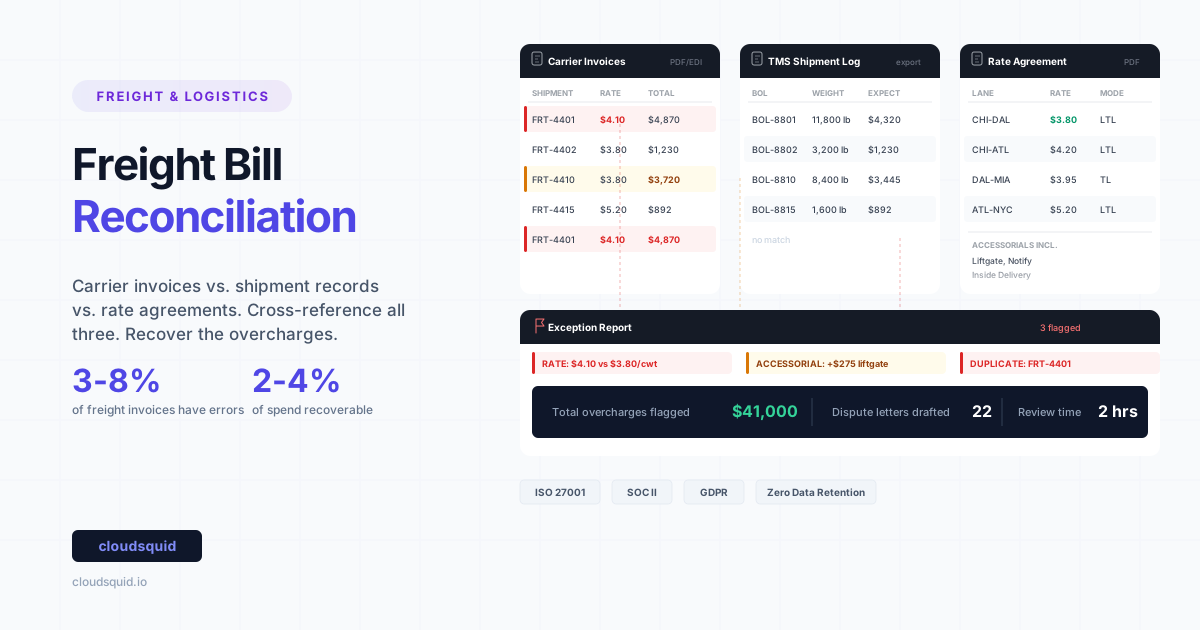
Freight bill reconciliation requires comparing three sources that almost never agree: the carrier invoice, the shipment record from the TMS or logistics system, and the contracted rate agreement.
The carrier invoice says the shipment cost $4,870. The TMS says the expected cost was $4,320 based on the weight and lane. The contract rate card says the base rate for that lane is $3.80/cwt, but the invoice was billed at $4.10/cwt with a fuel surcharge and two accessorial charges that may or may not be in the agreement.
Someone on the team has to reconcile all three, determine whether the variance is a billing error, a legitimate surcharge, or a contract violation, and decide whether to dispute. Multiply that by hundreds of shipments per month and the scope of the problem becomes clear.
For manufacturing and CPG distribution teams, freight is one of the largest controllable cost lines. Overcharges that go uncontested are not recovered. Most carriers have dispute windows of 60 to 180 days, after which the charge becomes permanent. The question is whether the team can reconcile invoices thoroughly enough, fast enough, to file disputes within that window.
What freight bill reconciliation needs to catch
A freight invoice can be wrong in several distinct ways, each requiring a different comparison against a different source document. The common pattern is a three-way cross-reference: carrier invoice vs. shipment record vs. rate agreement.
1. Rate discrepancies against the contract
The carrier bills at a rate that does not match the contracted rate for that lane, mode, or service level. A contract specifies $3.80/cwt for LTL shipments on a given lane. The invoice shows $4.10/cwt. On a 12,000 lb shipment, that is a $36 overcharge. Across 200 shipments per month on that lane, the annualized impact is over $86,000.
Rate discrepancies are the most common freight billing error. They occur when the carrier's billing system does not reflect the latest contract, when rate tiers are applied incorrectly based on volume thresholds, or when the carrier defaults to a tariff rate instead of the negotiated rate.
2. Weight and dimension disputes
The carrier bills based on a weight or dimensional weight that does not match the shipment record. The TMS shows a shipment at 8,400 lbs. The carrier invoice shows 9,100 lbs. The difference could be a re-weigh at the carrier's facility, a dimensional weight calculation, or an error.
Weight disputes are particularly common in LTL, where carriers routinely re-weigh shipments and adjust the invoice. The shipper's record of the actual weight at pickup is the basis for dispute, but only if someone compares the two.
3. Accessorial charges not in the agreement
The carrier adds charges for services that are not covered in the rate agreement, or that were not requested. A $275 liftgate charge when the rate agreement includes liftgate. A $180 residential delivery surcharge on a shipment to a commercial address. A $95 inside delivery fee that was never requested.
Accessorial charges are where freight billing gets opaque. Carrier invoices often list accessorial codes without descriptions, and the rate agreement may define some accessorials as included while leaving others at "tariff rate." Determining which charges are legitimate requires reading the contract, not just comparing numbers.
4. Duplicate freight invoices
The same shipment billed twice, sometimes with different invoice numbers or under different carrier accounts. This happens more frequently than expected with multi-stop shipments, interlined carriers, and shipments that cross carrier subsidiary boundaries.
A shipment from Chicago to Dallas with a stop in St. Louis might generate one invoice from the origin carrier and a second from the linehaul carrier for the same leg. Without cross-referencing BOL numbers across the full invoice batch, both get paid.
5. Service level mismatches
The carrier invoices for a higher service level than what was booked. A shipment booked as standard ground, invoiced as expedited. A shipment tendered as LTL class 70, invoiced as class 85.
Service level mismatches are easy to miss because the shipment still arrived. The overcharge is embedded in the rate differential between service levels, which requires comparing the booking record against the invoice line by line.
6. Fuel surcharge calculation errors
Carriers apply fuel surcharges as a percentage of the base rate, indexed to a published fuel table (typically DOE national average). The contracted fuel surcharge schedule specifies the percentage at each index tier.
Fuel surcharge errors occur when the carrier applies the wrong index date, uses a different fuel table than the contract specifies, or calculates the percentage against the wrong base amount. These errors are individually small (often $15-50 per shipment) but compound across volume.
Why most teams under-recover on freight
The economics of freight bill reconciliation work against thorough coverage. Each invoice requires pulling the corresponding shipment record, locating the applicable rate agreement, and comparing multiple dimensions (rate, weight, accessorials, service level, fuel surcharge). The time per invoice is high, the error rate is relatively low (industry estimates range from 3-8% of freight invoices), and the team has other priorities.
The result is selective reconciliation:
- High-dollar shipments get reviewed. Invoices above a threshold (often $2,000-5,000) are reconciled manually. Everything below is approved in batch.
- Accessorials are rarely verified. Base rate and weight get checked. Accessorial charges, which can represent 15-25% of a freight invoice, are approved at face value unless the total looks anomalous.
- Rate card verification happens quarterly, not per invoice. The team compares average cost per lane against the contract periodically. Invoice-level rate verification across every shipment is not feasible with manual processes.
- Dispute windows close. By the time an overcharge is identified in a quarterly review, it may be outside the carrier's dispute window. Carriers enforce these windows strictly.
Industry data suggests that companies recover 2-4% of freight spend through audit and dispute programs. The implication is that recoverable overcharges exist on a significant percentage of invoices. The constraint is not identifying them in theory; it is having the capacity to cross-reference every invoice against the shipment record and rate agreement in practice.
Moving the team from reconciliation to dispute management
The time-intensive portion of freight bill reconciliation is the cross-referencing: matching each invoice line to the shipment record, comparing rates against the contract, verifying accessorials, checking weights, calculating fuel surcharges. The valuable portion is the dispute management that follows: filing claims with carriers, negotiating credits, and identifying systemic billing patterns that need to be addressed at the contract level.
The Agent handles the cross-referencing. Upload the carrier invoices, the TMS shipment log or BOL records, and the rate agreement. Describe what the reconciliation should check:
"Compare each carrier invoice against the shipment record and the rate agreement. Flag rate discrepancies, weight mismatches, accessorial charges not in the agreement, duplicate invoices, service level mismatches, and fuel surcharge calculation errors. Produce an exception report with the variance per shipment and draft dispute letters for the clear overcharges."
The output is an exception report: every flagged shipment, categorized by discrepancy type, with the specific variance quantified (contracted rate vs. invoiced rate, weight differential, unauthorized accessorial, fuel surcharge delta) and the source evidence cited. For straightforward overcharges, dispute letters are drafted with the shipment reference, invoice number, contract clause, and calculated variance.
The team reviews the exception report and focuses on dispute filing and carrier negotiations. The cross-referencing work that consumed days is handled. The coverage is complete: every invoice, every line, every accessorial, every fuel surcharge. Every cycle.
The Agent works with the files the team already has: carrier invoice PDFs or EDI exports, TMS data extracts, rate agreement documents. No TMS integration or carrier portal connection required to start.
What the numbers look like
A CPG distributor with 12 carriers and roughly 800 freight invoices per month.
Before: The logistics team reconciles the top 20% of invoices by dollar value manually. The remaining 80% are approved in batch with spot checks. The team catches approximately $18,000 per month in overcharges, concentrated in rate and weight discrepancies on high-dollar shipments. Accessorial verification is deferred. Dispute windows are missed on roughly a third of identified overcharges due to processing time.
After: All 800 invoices cross-referenced against shipment records and rate agreements. Exception report surfaces 47 discrepancies across six categories. Twenty-two dispute letters drafted. The team reviews and files disputes in under two hours. Overcharges identified this cycle: $41,000. Annualized recovery improvement: approximately $275,000.
The specifics shift by industry:
- In manufacturing, inbound raw material shipments are often FOB origin, meaning the manufacturer pays freight but has limited visibility into carrier billing. The rate agreement is with the carrier, but the shipment was arranged by the supplier. Reconciling these invoices requires matching against the manufacturer's purchase order and the carrier's rate card simultaneously.
- In CPG distribution, outbound shipments to retailers and distributors involve complex routing with multi-stop deliveries, zone-based pricing, and retailer-specific delivery requirements that generate accessorial charges. A single shipment to three retail DCs might produce one invoice with twelve line items, each requiring a different comparison.
- In retail, parcel and last-mile delivery invoices carry dimensional weight adjustments, address correction fees, and peak season surcharges that vary by carrier and service level. The volume (thousands of parcels per day) makes manual reconciliation impractical even for a dedicated team.
Every comparison, flag, and source document is traceable. Carrier disputes are supported by specific evidence: the contract clause, the shipment record, and the calculated variance. When the carrier pushes back, the documentation is already assembled.
The recovery opportunity is in the coverage
Most freight audit programs recover 2-4% of spend by focusing on the highest-dollar shipments. The remaining overcharges, spread across the long tail of mid-range and small invoices, go uncontested because the cost of reconciling them exceeds the expected recovery per invoice.
Changing the cost of reconciliation changes the math. When every invoice can be cross-referenced against the shipment record and rate agreement regardless of dollar value, the recoverable amount includes the full distribution of overcharges, not just the top end. For teams managing $10 million or more in annual freight spend, that shift represents a meaningful improvement in transportation cost management.